Wednesday, August 10, 2011

The Three Most Important Words in Education: Assessment, Assessment, Assessment.


Today (August 10, 2011), Alfie Kohn posted a piece entitled, "Teaching Strategies That Work! (Just Don't Ask 'Work to Do What?')"
As I read it (with the usual enjoyment and anger Alfie Kohn's posts elicit from me), I found myself thinking about this paragraph in particular: "Thus, 'evidence' may demonstrate beyond a doubt that a certain teaching strategy is effective, but it isn't until you remember to press for the working definition of effectiveness -- which can take quite a bit of pressing when the answer isn't clearly specified -- that you realize the teaching strategy (and all the impressive sounding data that support it) are worthless because there's no evidence that it improves learning. Just test scores." 

In countless arguments I've had on-line with people about education and assessment in general, and mathematics education and testing in particular, invariably my antagonists (and I use that word advisedly) would reject any curricular materials, pedagogical strategy, tool, task, theory, activity, etc., by stating, "Where is your gold standard research that shows that X is effective?" And as night follows day, when pressed, they would make clear that inside that "gold standard" was what for them comprised a platinum standard: only 'objective' (and hence machine-scored, multiple choice tests if given on a wide-scale, or, if the assessment was small and local (e.g., in one classroom), only tests that were scored with no partial credit, no discretionary judgment or rubrics for the scorer, but rather those that had single answers that were either 100% right or 100% wrong, so that the results couldn't be shaped by the scorer (who might, of course, be inclined to be subjective or, even worse, fuzzy!) 

Now, I think we all want reliable and valid tests, but I find it intriguing that these folks were SO suspicious of any test that allowed for a "human" factor in the scoring (let alone one that had human factors in the tasks themselves, of course!), and so absolutely convinced that given practicality, costs, and the fuzziness factor they so abhorred, only those nationally-normed, multiple-choice standardized tests would count. They were the true measurement of anything one might wish to measure in education. 

Alfie Kohn raises the opposite question: what good are your 'results' if all they are is improving test scores, not learning? And these ideologues I finally gave up arguing with about 15 months or so ago only want to talk about just that: test scores, and a very particular type of test at that. With no wiggle room at all. As an advocate for increased intelligent use of meaningful formative assessment (see the work of Paul Black, Dylan Wiliam, et al.), I find myself realizing with increasing dismay that everything I value about education is precisely what is dismissed by the folks I'm trying to either convince or, yes, defeat in the court of not only reason, public opinion, and school policy, but in the halls of government and the meeting rooms of the monied and powerful. If I and others who agree with my viewpoint are not able to get people to see that improving scores on lousy tests is an utter waste of time by ANY reasonable criteria one might choose to use, then US public education is doomed.

 And we cannot afford to let that happen, to allow control to be ceded to self-interested greedy profiteers and people with various political, social, or especially religious agendas that are at odds with our democratic core values. Assessment, what it means, and how we do it isn't the ONLY issue we need to struggle with, but it tends to be the one that touches upon where the rubber meets the road for a lot of folks.
Naturally, I agree with people like Alfie Kohn, Marian Brady, and others who want to focus clearly on WHAT we're teaching and why we are teaching it. There's no getting away from content and the curriculum that frames it. But I think assessment remains key because it is still the one thing that people are guaranteed to pay attention to: kids, parents, teachers, administrators, politicians, media, and the general public. If we can't win the assessment fight, we're in very deep trouble.

Sunday, July 24, 2011

Trust Us, We're The ETS (And we have a nice bridge for sale in Brooklyn, too!)


This was today's (July 24, 2011) SAT question of the day from our good friends at the College Board and Educational Testing Service:

Read the following SAT test question and then click on a button to select your answer. 

If a, b, and c are numbers such that a / b = 3 and b / c = 7, then (a+b) / (b+c) is equal to which of the following?

A. 7 / 2

B. 7 / 8

C. 3 / 7

D. 1 / 7

E. 21


It's an old problem. I remember it from the '80s (some of the problems that appear in the Problem of the Day go back as far as the '70s). Nothing particularly wrong with it, nothing particularly great about it. But here's what bothers me, though it doesn't surprise me based on experience. Here's the explanation they offer:

Explanation

From a / b = 3 is implied that (a+b) / b = 4 (1)

And from b / c = 7 is implied that b / (b+c) = 7 / 8 (2)

If we multiply (1) and (2) together, we have that (a+b) / (b+c) = 4 times (7 / 8) = 7 / 2 ( b is canceled out).


Hmm. Well, maybe I don't know high school kids all that well after tutoring SAT math for 30-odd years, but I don't think very many of them would get that explanation or think to do the problem that way, assuming they tried to solve it. And that's one of my gripes with many of the ETS solutions to their own problems: they're generally not the quickest or most intuitive way to get at the answer.

My approach was to solve for a and c in terms of b, the variable that's common to both of the equations. It follows that a = 3b. Substituting for a in the expression (a + b) yields 3b + b = 4b. The solving for b in the second statement gives c = b/7 and substituting for c in the expression (b + c) yields b + b/7 or 8b/7. So the entire expression (a + b) / (b + c) in terms of b is 4b/ (8b/7). Indeed, the b's simplify to 1 (it's implied in the original problem that none of the variables are zero), and the rest simplifies to 4 * 7/8 or 7/2.

Maybe that's not "better," that what ETS offers, but I think it's more clear as to what's going on and why the approach works. The ETS explanation feels a bit like magic to me, looking at it from a student's perspective. That kind of thing in textbooks always frustrates me, and I know it loses a host of kids at the starting line. While this sort of answer from them may not be their most egregious sin, it is one example of why I warn students to not assume that when ETS explains something in math (or anything else) that it's always going to be coin of the realm. It's not wrong, but how helpful is it, really, for most kids?


Thursday, June 2, 2011

Open Letter to Arne Duncan Follow-Up


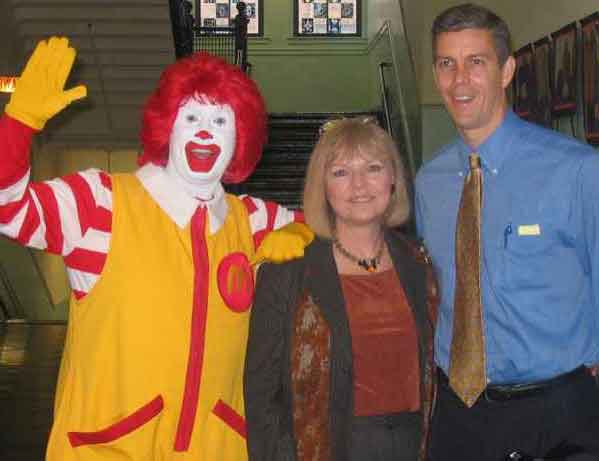
Ronald McDonald, Carol Spizzirri, Arne Duncan

 Yesterday, I posted here an open letter to US Secretary of Education Arne Duncan about a burgeoning scandal involving the Save-A-Life Foundation, its founder, Carol Spizzirri, and Chicago Public Schools under the leadership of Mr. Duncan.

Here are follow up links to a blog post the late Gerald Bracey was working on when he died in 2009, examining this same troubling situation.

First, two posts by Susan Ohanian: AN OPEN LETTER TO US SECRETARY OF EDUCATION ARNE DUNCAN.

Second, her original post of Bracey's column on Duncan and Save-A-Life:

News delayed is news denied.... The Skeleton in Arne Duncan's Closet

Ohanian's post of Bracey's column was picked up at the same time at two other sites, SUBSTANCE and SCHOOLS MATTER

Finally, here are two videos from Chicago's Channel 7 I-Team investigation of the Save-A-Life Foundation, "The Maneuver, Part I" and "The Maneuver, Part II."

Wednesday, June 1, 2011

An Open Letter To US Secretary of Education Arne Duncan


Click here for supporting documents regarding the following.


Michael Paul Goldenberg
6655 Jackson Rd Lot #136
Ann Arbor, MI 48103
(734)644-0975
mikegold@umich.edu
http://rationalmathed.blogspot.com

June 1, 2011

The Honorable Arne Duncan
US Secretary of Education
Department of Education Building
400 Maryland Ave, SW
Washington, DC 20202

Dear Mr. Duncan:

I'm a mathematics educator working in an urban public school district. On my blog, I'm reporting about the Save-A-Life Foundation (SALF), an Illinois nonprofit with which you were associated when you served as CEO of the Chicago Public Schools (CPS). I'd greatly appreciate your answers to two brief, but serious questions.

You'll recall that SALF's charter was to provide in-class first aid training to students. According to an October 11, 2009 Chicago Tribune article, SALF founder/president Carol J. Spizzirri claimed “2 million children took the classes, many of them from the Chicago Public Schools.”

According to news reports, press releases, and other records, from 2003 through late 2006 you lent your support to Spizzirri's organization in various ways, including appearing as an animated cartoon character on SALF's website.

Subsequently, a November 2006 ABC7 I-Team story reported that SALF and Spizzirri engaged in a variety of serious misrepresentations. In that broadcast, you yourself raise doubts about SALF's claims. Since then, the organization has been the subject of dozens more media exposes including an October 11, 2010 article in The Hill reporting that SALF was under investigation by the Illinois Attorney General's Charitable Trust Bureau. An investigation by the US Centers for Disease Control and Prevention also appears to be underway.

Here's why I'm writing. In response to a federal court subpoena and FOIA requests, the only records produced by CPS indicate that at best a few dozen students ever participated in SALF training classes. As result, Chicago Schools Inspector General James M. Sullivan has been asked to investigate what happened to approximately $62,000 CPS awarded to SALF, most of which was arranged by you. Records show that you contracted with Spizzirri to provide first-aid training for approximately 18,000 students from 2004-2006. You signed off on $49,000 in CPS funds and Ronald McDonald House Charities provided an additional $125,000, making a total of $174,000 paid to SALF for what appears to be a program that never happened.

Given the facts, do you think Inspector General Sullivan should proceed with an investigation? And would you co-operate with such an investigation?

Thank you for your consideration and I look forward to receiving your answers.

Sincerely,
Michael Paul Goldenberg

cc:
Justin Hamilton, Press Secretary
US Department of Education
Peter M. Heimlich, MedFraud.info

Sunday, May 22, 2011

You Say You Want A Revolution? Try Some "Inconvenient Truth" About Deformers


                                  Brian Jones and Julie Cavenaugh:
                                  Two Courageous Teachers

I had the pleasure and privilege of attending the premiere of THE INCONVENIENT TRUTH BEHIND Waiting For Superman on Thursday night and hearing the excellent panel discussion afterwards. This is a movie that, as Diane Ravitch said, needs to go viral. Go here to request a copy: http://www.waitingforsupermantruth.org/ Consider showing it wherever you can. And think about this: we're individuals, working collectively, to fight a small number of billionaires and their pawns and puppets. There are vastly more of us than there are of them. Our futures and those of our children and grandchildren are at stake. The very essence of democracy and the role of free public education therein are facing serious threats, not from foreign forces or terrorists, but from corporate interests and the super-rich. Every major US city, particularly where there are a lot of poor and minority people, faces a direct threat from privatization, but ultimately, if the deformers are allowed to win, they will spread their poison everywhere.

Consider making versions of ITBWFS that focus on your city or region. LAUSD, Chicago, Washington, DC, Baltimore, Detroit, New Orleans, Philadelphia, St. Louis, and Miami are some of the most immediate, obvious targets, but no doubt there are many others.

Diane Ravitch said on Thursday that no billionaires are coming to save us or do the hard work for us. We have to do it ourselves. And it's about time we did.

Thursday, May 19, 2011

Fear and Loathing in Calcville: Who Makes Kids Anxious About Math?


Recently, another study (Researchers Probe Causes of Math Anxiety: It's more than just disliking math, according to scholars) has appeared proposing to explain the causes of mathematics anxiety. It shows up as part of a book called CHOKE: What the Secrets of the Brain Reveal About Getting It Right When You Have To, by Sian Beilock. If what's in the article is an accurate depiction of what the study has to tell us, there's not much new to see. 


On my view, math anxiety is obviously not something many people, if any, are born with: for the most part, we catch it from others. However, it is worth noting that there are many carriers who are not themselves suffering from the disease. Contemptuous, arrogant mathematics teachers can readily drive someone into math anxiety, and frequently do, I strongly suspect. So can rigidity about what doing and being "good at" mathematics entails. Given how most US teachers present the subject in K-12, math is only or primarily the following: calculation, arithmetic, and speed (with accuracy, of course).


Yet none of those things are particularly what mathematicians deal with. No mathematician is judged by speed of calculations - arithmetic or otherwise. Calculation may not even be a particular strength of a professional mathematician. Mathematicians by and large deal with abstractions, patterns, connections. Of course, some deal with applications of mathematics to sciences and engineering and other "real world" problems and situations, some straddle the territory between "pure" and "applied mathematics," and most couldn't care less whether what they work on has applications beyond mathematics itself.  Calculation isn't their interest and they know that when it comes to pure calculation, it's hard to beat a computer for speed and accuracy. They also know that the computer won't offer  insight, leaps of heuristic thinking that connects seemingly unrelated ideas in two or more areas of mathematics, or the recognition of underlying structural similarities, etc. While by definition computers excel at computation, the fact remains that they don't think or "do" mathematics.


Unfortunately, neither do most American schoolchildren after a few years of exposure to what accurately should only be called "school math." Is it any wonder that, confronted in early elementary school with high-pressure tests that demand the calculation of 100 arithmetic problems (mixed or not) in 3 to 5 minutes depending on the teacher or school, many students just bail out of mathematics for the rest of their lives? The "stand and deliver" approach may work for those kids who happen to be quick at the given task demanded of them (I was one such kid) and enjoy the concomitant competition, but for many that's the fast track to tuning out mathematics permanently.


Of course, I was no more doing mathematics when I crunched all those numbers quickly and accurately than is a computer today when it does in a nanosecond what it took me a few minutes to complete. It took me close to another thirty years to find out what mathematics actually is about. And I'm one of the lucky ones: I stumbled into more useful viewpoints about the subject, along with learning a reasonable amount of mathematics. Most Americans don't: not because they were born deficient in the ability to do and appreciate "higher" mathematics, but because they were denied the opportunity to get anywhere near higher mathematics due to an approach to the subject that is demeaning, alienating, and clearly grounded in some sort of bizarre notion of competition and "winnowing wheat from chaff." Who knows how much mathematical talent is wasted every day in our country due to such absurd notions of the subject and its teaching? For how much longer can we afford to tolerate such an anemic view of  this vital, powerful, and - dare I say it - beautiful discipline?