Monday, August 6, 2012

What Makes Johnny (and Charmaine, and. . .) Run? Of Carrots, Sticks, and Education

One Way To Motivate


Motivation is a rather intriguing topic in the world of education, particularly these days, given all the expert opinions the corporate world is offering to or more often blatantly imposing upon public schools, districts, administrators, parents, and children. Of course, teachers themselves are always seeking guidance from more experienced and/or successful educators on how to get kids to behave and do what is demanded and expected of them in and out of class.

On July 31, 2012, writing on her About.com Secondary Education page, Melissa Kelly tried to address the question of how to motivate students when she wrote:
One way to motivate students both behaviorally and academically is to reward them in various ways. I've created a list of ten ways that you can reward middle and high school students. Enjoy!
Here is the list of motivators Ms. Kelly recommended (I will only reproduce their names, not the details, here; click on the link for the whole thing:

1) Sit where you want for the day;
2) Class party;
3) Homework pass;
4) Games day;
5) Extra credit;
6) Small rewards;
7) Water day;
8) Extra computer time;
9) Popcorn party;
10) Take care of the class pet.

Before continuing, I need to make clear that the above list is offered to secondary teachers. In some ways, that's surprising, but I suspect that a very large number of teachers will be familiar with most or all of them, regardless of the grade band in which they teach.

I won't comment on most of these (and didn't remark directly on any of them on her blog), but must here object in particular to the third one. What message does it send to kids about homework if one is rewarded by not having to do it? Please note, I'm not suggesting that homework is something I favor, but merely that it speaks volumes to what even teachers believe about it if they consider it a motivator to give kids a free pass from doing it. If the message of that isn't, "I know I tell you all the time that homework is vital for doing well, and I require that you do it to pass (hence, I give marks for it), I've been lying, because I'm willing to let you get out of doing it, or at least some of you, as a bribe for doing something else I want you to do. So don't believe what I said about homework. Except pretend you do. And you can certainly trust the truth and sincerity of the OTHER things I tell you," then I don't know what it IS saying in reality.

In any event, here is the initial comment I DID leave:
I thought learning and doing meaningful work were their own reward. Why would students need to be bribed into participating in lessons that addressed their inborn needs to make sense of their world? Of course, if the lessons are irrelevent drudgery, bunches ‘o facts disconnected from anything that matters, even obliquely, to the students, I can well-understand the need to provide extrinsic motivation in the form of bribery.
Several replies followed, two of which are worth copying here:
1) Kathleen Bailey says:

Mr. Goldberg [sic], I don’t think you are a teacher. We work so hard to keep the students engaged in learning, to think well of themselves before, during, and after the learning process….but sometimes just a little reward can make a difference. It’s a visual something…I got this sticker because I worked hard to learn; it’s a reminder every time they see it. Teachers, before so many laws about nutrition came into our classrooms, used to be shameless and happy to dispense candy for learning. I just want them to learn and I don’t mind spending my hard earned cash for little prizes. I do not have to do it that often, but I don’t mind a bit. Movie day for weeks and weeks of work on a research paper is a good thing!

2) James Clark says:

With all due respect to Ms. Baily, Mr Goldberg [sic] is correct. I’m a teacher, and I know. You, as a teacher, must feel the bigger issue is that we are forced to bully kids into a simplistic understandings that can boiled down to a multiple choice test. Through an ignorant allegiance to standardized test scores we have a we have sneak love of learning in between preparation for quizzes. To you Mr Goldberg [sic] I would add that I use motivators of every kind. However, the bigger issue is high stakes testing and teacher bullying. You need to tell your principal today (call… I’m he or she is there) and say that you (and all your friends as well perhaps?) want standardized testing to stop. Teachers should be allowed to do what they signed up for… teach and inspire.

And those led me to write what follows:

I appreciate the responses. For what it's worth, I've been in education since 1973. I've taught at the high school level, worked as a field supervisor for secondary and elementary teachers for the Univ. of Michigan, done research in middle school math classrooms, been an elementary and secondary math coach, and done professional development work with K-12 teachers in mathematics. I've also taught math content and methods courses for elementary and secondary teachers at several colleges and universities, and been a mathematics instructor at community colleges in NYC and Michigan.

So yes, I'm a teacher. And I'm also a staunch critic of high-stakes standardized tests.

But I think there's a key point that may have been overlooked, one I intended but didn't make explicit: if you have to bribe/reward kids, there's something wrong. Whether it's that outside forces (e.g., NCLB, Race to the Top, the Common Core) or more internal/local ones (principals, departments,  districts,etc.) that push bad curriculum and "standards" into the classroom, or whether teachers simply aren't asking themselves what actually matters to kids (and please, I'm neither stupid - my son is 17 - nor cynical: kids WANT the world to make sense, and it's up to educators to help them do so. But we mostly don't for a host of reasons.

If you could teach any relevant content you wished, it would behoove you to frame your curriculum around what kids want to know to make sense of their world. Every "subject" is relevant in that regard, at least potentially. We could, if we thought about it, worked with other teachers and curriculum specialists in an inter-disciplinary way, construct units and lessons that addressed what kids want to know. And they DO want to know.

But if you're a secondary teacher, chances are enormous that many if not most of your students are already ruined for learning by the time they reach your classroom. They've been "schooled" to only care about grades, not learning, IF they even care about those. A few may actually want to know things for their own reasons outside the context of the school game, but they aren't the way they are because of some inherent flaw. Rather, we taught them to be that way from early on, and they learned the lessons we taught only too well. Early elementary kids are full of energy and curiosity and life, eager to learn for the most part. By third or fourth grade, much of that has been bent by well-meaning teachers and a system that corrupts everyone.

Please consider how YOU as a teacher have been corrupted by a carrot-and-stick system. It's more blatant now than it's been since unions first arose to make things more fair for professional educators: the new education "reformers" (or as I call them, deformers) are playing a bunch of the same silly "motivational" games with teachers that many teachers believe they must play with their students. And few experienced teachers LIKE the games that are being played with them now, but fail to make the connection between what they do to students (or feel they MUST do) and what the for-profit education deformers are doing to teachers.

It's ALMOST ironic.

I want to close by mentioning several people whose work; as well as public and private writing, speaking and thought have been deeply influential on what I've had to say here: A.S. Neil, Tim Pitkin, Wilhelm Reich, Alfie Kohn, Lynn Stoddard, and Marion Brady. I thank all of them for their humane, child-centered ideas about education and children.

Saturday, August 4, 2012

An Open Letter to Barack Obama About Education


Dear Mr. President:

I write this on your birthday to wish you the very happiest of days. But I also write to speak to you as a parent, educator, and someone who deeply believes in our democratic heritage and values.

When you spoke to the nation after the recent tragedy in Colorado, you appealed to people first as a father, shocked by something he knew could have happened all too easily to his own children. I, too, am a parent. My son is a fine young man of 17 who has attended public schools all his school life. And as someone who has worked in public education for 42 years, I know intimately the strengths and flaws of our education system, about which I comment in these pages and elsewhere on a regular basis. Almost all my professional work over the past 20 years has been in high-needs, inner-city schools of poverty, in Detroit, Flint, Pontiac, and New York City (including the South Bronx). And there I have seen poverty and squalor that most Americans can't even begin to imagine, including schools that would be shocking even in third-world countries. I would love to say that what you've accomplished regarding education since you took office is make real in-roads in our neediest schools and communities, but to do so would be a lie.

As long as Arne Duncan is US Sec. of Education, you will be promoting an undemocratic approach, heretofore unprecedented in our history, to imposing federal will on state and local educational practices. Were the policies your administration is effectively enforcing states to adopt good ones (which they are not), I would still hesitate to support the MEANS through which you are promoting them. But as they are not, I am doubly worried about the precedent you are setting for the next George W. Bush, Ronald Reagan, or worse: since YOU forced states to accept Race to the Top and the execrable Common Core State (sic) Standards, why won't the next Republican president feel free to force through mandatory vouchers, the forcible breakdown of the separation clause, and much else even more heinous? If past is prologue, you know as well as I that they will not hesitate for an instant. And your approach to educational deform (for it is NOT reform in any traditional sense) will be used repeatedly to justify further disasters.

Duncan must go. Policies that play into the hands of corporate educational deform must go. Allowing high stakes tests to determine our policies must go.

When you were elected in 2008, progressive educators throughout the land celebrated what we saw as a return to national sanity. We believed that you would appoint an educator like Linda Darling-Hammond, Diane Ravitch or Deborah Meier to lead the DOE and bring real classroom teaching experience to bear in improving policy. Instead, you gave us Arne Duncan, a soulless, clueless, corporate drone, a man who manages to insult professional teachers (and parents, and kids) nearly every time he opens his foolish mouth and lets out his ideas about "fixing" schools.

End the madness. Make your second term the best in the history of US education by rejecting corporatization and privatization of public schools. Shut your ears to the siren calls of Bill Gates, Eli Broad, the Walton, Coors, de Voss, and other right-wing and shamelessly greedy foundations, and leave a legacy your children and grandchildren will be proud of. Your kids go to one of the finest PRIVATE schools in the country, while the rest of the black kids in DC are living in the disaster that Michelle Rhee helped make worse and even further steeped in corruption and dishonesty. The high stakes tests don't tell us what kids know or can do. They bring down the integrity of education. They are, simply, a plague upon the land, serving the interests only of their publishers and some very blind politicians.

YOU can make a real difference by speaking out HONESTLY about how poverty and financial inequity slants the educational playing field and rigs the game to the extreme disadvantage of poor and minority students. Every politician pays lip-service to the notion of fairness and the vital importance of quality education in helping make meaningful change for the good, but few if any DO anything useful in this regard.  By supporting truly equal opportunity for everyone, a real chance for life, liberty, and the pursuit of happiness, by including the right to a high-quality education, like the one your daughters are getting, you can help bring about real social change, change that will never come through today's high-needs education: full-time test preparation that kids in Detroit, Philadelphia, New Orleans, Houston, Los Angeles, and many other places are given, whether or not they and their parents like it. Testing isn't teaching, Mr. President, as you have acknowledged but failed to address with good policy. The time to commit to positive change is NOW.


Saturday, July 28, 2012

Garfunkel Simonizes the Mathematics CCSS (and I Feel Fine - sort of)

Sol Garfunkel

Sol Garfunkel has just come out against the CCSS in math, while admitting that he'll also be working to help implement them as effectively as he can. Not in some obscure locale, but in an AMS journal, the 8/2012 issue of the Notices.   And I feel fine about it, more or less.

He makes clear that he feels his contributions as a writer of the CCSS were effectively ignored. I find that utterly believable for reasons that are likely clear in the AMS piece.

 I wrote a blog post in 2011, "A Partial Bridge Over Troubled Mathematical Waters: Mumford and Garfunkel Try To Fix US Math Education," in which I critiqued Mumford and Garfunkel's take on how  get things done right in math ed. Even there, it's clear that Sol didn't care for CCSS. I don't know that I realized just how things had gone for him in the writing process, however.

I've hardly been shy about my objections to and skepticism about CCSS. I remain absolutely convinced that what will happen in terms of how mathematics is taught in this country will be nothing good at all.

Having just started re-reading THE TEACHING GAP, 13 years after its publication, 18 years after the TIMSS video study, and with 20 years of teaching and observing other teachers of various levels of experience, from student teachers to 20 and 30 year veterans, I believe that the commentary James Stigler and James Hiebert offer was accurate in the claim that there was little or no evidence of progressive reform teaching (regardless of what textbooks were used) in the US at that point. I agree with what Jim Hiebert said to me at the NCTM Research Pre-session in Philadelphia in 2004: one could stick a pin in a map of the United States, pick a school in the nearest district, pick a math class or lesson in a random school in that district, and that the probability of seeing a progressive reform lesson being taught in the manner proposed in the NCTM Standards volumes from 1989, 1991, and 1993 or 2000 was effectively zero. I believe that's still true today. And I am completely confident that if there is another TIMSS video study done in, say, 2024 after a decade of implementation of the all-important high stakes tests that are being developed for roll-out in 2014, there will still be an effective probability of zero of turning up the sort of thoughtful teaching NCTM had in mind, that appears in the Japanese middle school math lessons from 1994, and not by a long shot. We are stuck in an endless cycle of mindless rote lessons that focus exclusively or nearly so on calculation and algorithms, meant to be memorized and regurgitated by students, taught without any sense of what makes mathematics interesting, powerful, or beautiful. Just a bunch o' facts absorbed for the short-run in order to "pass." And on my view, this is a crime being committed against ourselves, our nation, our children, and our children's children and grandchildren.

Sol Garfunkel gets it exactly right when he describes the oppositional behavior of certain groups and individuals during the Math Wars. And it is a safe bet that anything of value that made its way into CCSS will be watered down, ignored, or fought against doggedly until it vanishes from view. Between the idiocy of yet another top-down approach at effecting real change in individual classrooms, schools, districts, and states, and the absurd educational policies of the clueless Arne Duncan and the rest of the Obama Administration and both houses of Congress, things will only get worse before they get better. Whether they'll EVER get better for more than a small handful of kids lucky enough to encounter real math teaching and learning begins to look more and more doubtful.  As I have argued elsewhere, NCTM, NCSM, and other mathematics education organizations have truly sold out the nation on this boondoggle. Things are no better with NCTE and literacy and literature education. No billionaires are coming to support something better. We have to do it ourselves by staying true to the project of creating great math classrooms, one teacher at a time, and getting the word out ourselves, while fighting the forces of resistance and reactionary thought.

Thursday, February 23, 2012

Khan, you bloodsucker! KHAAAAAN! (More musings on the Khan Academy)


Why do many well-meaning (and some not-so-well-meaning) people think that the Khan Academy is THE panacea for various woes, perceived and real, in US mathematics education? Perhaps no one has expressed love for Sal Khan and his on-line videos than a recent anonymous commentator on my last blog piece (way back in November 2011): "Wont' Get Khanned Again: How Can Education Help Democracy Trump Capitalism?"

This anonymous poster wrote:
I am a student studying in grade 11 and all I am concerned with is what you have said about Sal Khan. I have a great amount of respect for him since he is the reason my maths mark went from a 55 to a 78 and my chemistry mark went from a 66 to an 83. All this happened over the coarse of 2 months! I understand that teachers work hard to teach the kids but at the same time, not all kids pick up everything the teachers say. And in most subjects if you miss one small bit of information, you will be lost for the whole topic. Now I know that extra help is provided my almost every single teacher but nowadays almost every kid is involved in extra curricular activities. So, when I would get home I would not understand a single thing and therefore not do my homework and get bad grades, but ever since I have discovered KhanAcademy, I would come home from practice and watch Sal Khan's videos. I learned so much, I caught up on what I missed in class and started doing better and better. Since its so easy to rewind, fast forward, and pause a video, I would learn the topic in no time! so for every teacher out there thats hating on Sal Khan, you should all be thankful that he provides kids with tuition that you just cant. I love the methods he uses to teach and hopefully he will keep this going till he has almost every single topic covered there is. May Allah(swt) Bless him. Keep it up Sal Khan!
Well, I couldn't let that go unanswered, even though I would have preferred to have someone to reply to directly (I have a long, uncomfortable relationship with anonymous and pseudonymous posts and posters on the Internet. It would take a longer explanation than I'm willing to give at this point, but suffice it to say that I have come to the conclusion that if you have something to say you're not willing to put your own name on, something's probably rotten in Denmark, or from wherever it is you're posting. Short of adding a pseudonym for satirical purposes (while still making clear enough that you're the author), there aren't a lot of circumstances in which posting without honest attribution strikes me as justified). But I digress.

Here is my response to the worshipful but thus far unnamed fan of Khan:

As a rule, I try to keep Allah, Buddha, Jehovah, Jesus, Zeus, Odin, Jupiter, Krishna, and other members of various pantheons out of the conversation: there's barely enough room here for the humans without getting gods into these narrow spaces.

But all that aside, here's my very serious, very direct view about what you had to say:

You may have legitimate complaints about math classes, assuming that you don't merely take issue with getting poor grades or judge the quality of either content, teaching, or much else in the classroom or on a free video strictly on whether you're doing well or poorly in a course. Because if the latter is the case, you and I aren't going to have much useful to say to one another.

Another point you touch upon is that if students "miss one small bit of information" then they are lost for the whole topic. I would suggest that what you're dealing with there is, on the one hand, a legitimate complaint about the model for delivery of content to which you and most students are subjected, but that on the other hand, if you were really being taught mathematics (rather than "schoolmath"), you might be making connections on your own sufficiently that missing one little bit wouldn't be quite so fatal. You might actually be able to think about the missing little piece and figure it out. Not always, perhaps, but not never.

But all of this is somewhat moot because, I fear, you've swallowed, through no wrong-doing on your part, a rather gigantic myth. You think your teachers are teaching actual mathematics. And that Sal Khan, his academy, and his videos, are making up for either less wonderful instruction in real mathematics or missing bits of instruction in same.

The fact is, you're not being taught math, and Sal Khan doesn't offer math, either. There is little or no mathematical thought going on in your math classroom. It's not inconceivable to me that if behind a screen, a computationally-able human being and a computer were each producing answers to the exercises you're being asked to deal with, and the only thing you saw was a printout of their respective answers, you'd be unable to tell which was the human and which the computer.

On the other hand, if real mathematical thinking and problem-solving were involved, the computer wouldn't be able to produce answers - at least not if what were input consisted of the same exact words that the human read off the page and then grappled with. Because computers don't think. Neither do they do mathematics. What they can do is crunch numbers, compute, and then do things that are impressive with the results (like graph, manipulate the results in a host of other ways, and give you a printout or screen filled with output.

The blessed Sal Khan doesn't really address mathematics, either. What he and his videos offer you are mini-lessons on how to be a slow, less-reliable computer than the sort they've been selling on the cheap for quite some time. If that's your goal (being a cheap, slow, not always accurate machine), then Sal is no doubt someone you should adore, though frankly I think there are much better on-line resources out there that do pretty much the same thing.

I have no gripe with Khan or 1,000 other people providing such services, whether free or for $$ (if they can find people willing to pay them). I occasionally tutor mathematics, and generally expect to be paid for my time and expertise. But then, I offer something that Sal doesn't: I help students make SENSE of mathematics, to THINK about what they're doing, where it comes from, where it might be heading, how it connects to other things they know or would like to know, and why any of it is worth knowing. So I can honestly claim to be offering tutoring services in mathematics. I don't believe that Khan can. He should be honest and state that he's offering little video treatments of topics in school math, the mastery of which will raise your grades and make you more like a slow, unreliable, more limited version of a TI-83+ or maybe, on a good day, a TI-89. But you won't know mathematics or be able to solve mathematical problems (as opposed to computational exercises and empty symbolic manipulations) any more than can those hand-held devices.

I can't comment on Khan and chemistry. First, I've never watched any of his chemistry videos. They might be superb. But second, I'm utterly clueless about chemistry for the most part and wouldn't presume to judge the content of his videos (though I might well be in a position to weigh in on his pedagogy).

As for 'hating on' Sal Khan, I do in fact have objections to a lot about him, what he has to say, and how he operates. But that's besides the point and not in any way a shot at how wonderful you feel when you improve your grades in schoolmathematics. I just wish he would engage in a bit of 'truth in advertising' as to what he's really offering, and that Bill Gates would stop using his bully pulpit and gazillions of dollars to try to convince everyone that the Khan Academy is the real McCoy of mathematics education. Because it might be many things, but it most assuredly is NOT the real McCoy. It's pablum, meant to appeal to people who are being misled by their mathematics teachers, their textbooks, etc., as to what mathematics really is and what it means to be doing it. If Khan were charging you, you might well have grounds to file a complaint with the Consumer Protection Agency (assuming that the lunatics in Congress don't do away with that in short order).
Sue Van Hattum kindly wrote in reply to the above: "Michael, I love your reply. I think this is the first time I've seen the Turing test applied to math ed. :^)

I've no idea if I've broken new ground, but regardless, it seems like a line of thought worthy of pursuit. If what your math teachers are offering you in K-12 (or if you're a K-12 mathematics teacher who offers that which) won't pass the Turing test, maybe they (or you) should be replaced by computers. Oh, wait: that's exactly what I suspect Bill Gates and the educational deformers would adore. Then they wouldn't have to bother paying even the generally low salaries most charter schools offer (apologies in advance to the good charter schools with fair pay and contract policies) and could hire a few folks with a combination of skills in computer technology and guarding prisons and save a packet.

One last thing: I found a very provocative take on Khan Academy that explores some of the reasons I find Mr., Khan and his work so vapid and disturbing. Please take the time to check out Frank Noschese's "You Khan't Ignore How Students Learn."  And the rest of his blog looks very much worth exploring for reflections on teaching.


Monday, November 21, 2011

Won't Get Khanned Again: How Can Education Help Democracy Trump Capitalism?


The other evening, I saw an article about Salman Khan's latest plans to expand his "education" empire into the world of brick and mortar schooling (how unrevolutionary of him, I must say), and it set me to thinking. One sentence caught my attention in particular:
"They played a 'paranoia' version of the game Risk to understand the theory of probabilities using Monopoly money, where kids trade securities based on the outcome of the game."

There's nothing obviously new about this: there have been teachers offering stock market simulation "games" in various grade bands for decades. So what's the big deal? Maybe nothing, maybe something significant. Here we have Sal Khan, former Wall St. hedge fund analyst (not a job for which I hold a great deal of respect, for some reason, particularly in connection with the education deform movement), giving summer campers, some of whom by his own words, "couldn't see the board" (which I assume means that they were quite young), the opportunity to find out how our capitalist system works. Not that the word "capitalist" or its variants ever gets mentioned of course. But it's certainly Sal's prerogative to indoctrinate   proselytize   rationalize  um, expose students to The Market.

What popped into my head was, "How do educators (in mathematics or any other subject) who are concerned not only about social justice and the obvious inequities (and iniquities) of the current American system give students the opportunity to critically examine the assumptions about what it means to be human that are inherent in our so-called "free-market" capitalist system and how that system impacts our alleged belief in "core democratic values."

For those of you not playing along at home, let me remind you that the reason we've fought wars over the last 60 years in places like Korea, Vietnam, Panama, Nicaragua, Somalia, Kosovo, Iraq, Afghanistan, and Libya (to name just some of the low-lights; for a more thorough list of our military interventions, both foreign and domestic, over the last 120 years or so, go here), is to spread our "democratic core values" and bring freedom to oppressed people throughout the world (or so I've heard it said). Yet, some people lately have been making a lot of noise that includes the notion that we don't really have democracy or anything vaguely like it here at home. And some folks are linking capitalism and the activities of Wall Street, banking, multinational corporations, globalization, and much else that I suspect Mr. Khan finds perfectly fine, to the absence of meaningful democracy, social justice and equity in these United States.

So while I can't stop Sal Khan from expanding his influence into the hearts and minds of our children, particularly since Bill Gates isn't backing my on-line screeds financially or otherwise, nor has the O'Sullivan Foundation offered me $5 million in grant money to spread my vision to physical classrooms, I guess I'm still free (until the Internet comes under complete control of the government and its corporate and oligarchical masters) to try to get others interested in offering kids a different viewpoint. In particular, I invite people to offer ideas (information on and/or links to already-existing projects, speculations on projects that might be, or inklings of possibilities) on non-didactic education (how's that for an oxymoron?) on the human and humane implications and costs of unchecked capitalism.

My initial thought last week was that I wanted a game that allowed students to explore various economic, social, and political arrangements and systems in ways that made it likely (perhaps unavoidable) that players would need to think hard about what it costs people to live and work in our system, not just Americans, of course, but people all over the world, and not just monetarily, but in terms of physical, intellectual, emotional, ethical, spiritual, and other aspects of what might be called human health and well-being. Naturally, the environment in which we live, the planet we inhabit, would likely need to be considered carefully as well.

Lest I appear more completely ignorant than I actually am (which is, of course, quite ignorant of a host of things), I should mention that I'm aware that Bucky Fuller was up to something at least in part like what I'm raising above with his World Game. I'm most certainly not in his league, but I'm thrilled to have discovered in reading about his game ideas that during the 1960s, Fuller several times proposed them as the core curriculum for Southern Illinois University. I'd like to see his college curricular idea and raise him a K-16 and beyond curriculum, one that begin as close to the start of formal education as possible and  finds ways to lead students into conversations about the what happens to us when we operate in a capitalist mindset. I think there are fundamental ethical questions and assumptions that kids of school age care about and are quite capable of discussing intelligently.

I do put in that oxymoron about non-didactic education advisedly. There's no question that it's possible to readily create lessons the entire point of which is to propagandize an anti-capitalist moral. That's not what I'm interested in, however. I think that if such a curriculum is to be useful, it needs to be much more open-ended than what being the flip side of Mr. Khan's little market game seems grounded in. But maybe I'm chasing a chimera here. What do you think?

Friday, October 28, 2011

Huh? The ETS Discourages Thinking Again


Every day, the ETS/College Board kindly  e-mails to subscribers an "SAT Problem of the Day": about one in every four is a math problem. Twisted soul that I am, I frequently start my day by answering the problem of the day, and while I'm generally able to nail better than 98% of them, I particularly look forward to the math problems, and even more so to ones that relatively few people who've attempted them have gotten right (yes, I'll admit to still having a sad little place in my soul that is stroked by such silliness).

This morning's poser was definitely challenging for a majority of respondents. As of this writing, with nearly 80,000 folks attempting the problem, only 40% had answered it correctly. Before we continue, here it is for your smoking enjoyment:

The stopping distance of a car is the number of feet that the car travels after the driver starts applying the brakes. The stopping distance of a certain car is directly proportional to the square of the speed of the car, in miles per hour, at the time the brakes are first applied. If the car’s stopping distance for an initial speed of 20 miles per hour is 17 feet, what is its stopping distance for an initial speed of 40 miles per hour?

(A) 34 feet   (B) 51 feet  (C) 60 feet  (D) 68 feet  (E) 85 feet


Okey-doke. I'll give you some time to think about it, preferably before you look further down the screen for the official answer and explanation. And it's that explanation I want to address. No peeking now! After all, your self-esteem is riding on how well you do here (not to mention your entire future). 

All done? Great. Now before we see the official explanation/answer, let's take this opportunity to do what the folks in Princeton and Berkeley (East and West Coast headquarters of the ETS) apparently don't want us to do: think!

First of all, were this problem to appear in an actual test (despite my enormous collection of past actual SAT tests, I don't recall having seen this one before), my best guess is that it would be one of the last ten problems or so in a section of mathematics problems, based on the 40% correct response rate (I've seen math problems where fewer than 10% of students attempting it got the right answer; as I have no way of knowing what percent of the folks who answered this one today are actually high school students, this might actually be a bit harder for the intended audience than the numbers indicate). It seems fair to suggest that this isn't something that is ridiculously difficult, but that many high school students would nonetheless get wrong for various reasons.

One reason, of course, is literacy: if students read this carelessly or are unable to comprehend the point, they may overlook or simply fail to understand the significance of the words "directly proportional to the square of the speed of the car." If so, one obvious trap answer, a distractor, if you will, that will draw a disproportionately high number of incorrect replies, is (A). It's relatively easy to miss/ignore the word "square" and figure that since 40 mph is twice the speed 20 mph, the stopping distance will be twice that of the slower car and hence 2 x 17 ft = 34 ft. 

But if you're on your toes, even if you're not a math whiz you should be suspicious of this answer. It's just too damned easy to come up with. A late-appearing SAT or ACT math problem isn't going to be quite so simple.  And in fact, any simple equation you set up here that ONLY involves the given numbers and an unknown will be wrong. That "square" thing isn't put in for show, and it's going to come into play somehow or other. 

Sometimes it's possible on problems at this level of difficulty to do more reasoning and eliminate additional choices after avoiding the "big trap" answer. I've not thought this one through further other than to solve it, but perhaps interested readers can offer ideas as to why the other three wrong answers were chosen by the test-makers as possible replies. For me, the problem itself spoke to such a simple solution that I just cut to the chase and answered it. And then, I eagerly awaited learning what the experts had to say as to why my answer was (of course) correct. ;^)  So with no further ado, here is the official explanation from the ETS/College Board:
 
Explanation

The stopping distance is directly proportional to the square of the initial speed of the car. If s represents the initial speed of the car, in miles per hour, and d represents the stopping distance, you have that the stopping distance is a function of s and that function d of s = c times (s^2), where c is a constant. Since the car’s stopping distance is 17 feet for an initial speed of 20 miles per hour, you know that 17 = c times 20^2. Therefore, c = 17 over 20^2 = 0.0425, and the car's stopping distance for an initial speed of 40 miles per hour is 0.0425 times 40^2 = 68 feet.

Say what? Gosh, but that seems like a hell of a lot of work to me, and quite frankly, 0.0425 never came into play in my calculations.  Having done (way too) many SAT/ACT math problems, when I see something that involves ratios (usually geometry problems, but the underlying issue here is the same), I think about dimensions: am I looking at a linear/linear ratio (if it's a challenging problem, probably not)? If not, is it linear/square? Linear/cubic? Some other ratio where the dimensions change? In this case we're looking at a proportion in which we have a linear ratio (speed to speed) that is being set equal to another linear ratio (braking distance to braking distance), but we're told that the second varies as the SQUARE of the first. So we've got (20/40)^2 which simplifies to (1/2)^2 or 1/4. Thus, the other side of this proportion needs a number on the bottom (conveniently, our unknown) that is 4 times the number on top (17) - of course, you might set things up another way. As 4 x 17 = 68, that's the right answer. Doable, I might add, in your head if you have a bit of facility with mental arithmetic. On the other hand, I challenge you to do the number-crunching in the official explanation in your head. Not impossible, of course, but not exactly as simple as squaring (1/2) and then multiplying 17 by 4 (one way is to take (15 + 2) x 4 = 60  + 8 to get a total of 68.

My point is, of course, that the best place to go for explanations on SAT/ACT math problems is not the test-makers. Considering that these are timed tests, they will NEVER do a "process of elimination" approach, which is necessary when you don't know how to proceed (and when you have to deal with certain question structures, both in math and elsewhere, where it's much easier to eliminate wrong answers than arrive at the right one). They'll never talk about the errors they presume you'll make or the whole concept of distractors. Nope, that would be a bit too helpful. And it would undermine the nice illusion that want us all to harbor that these tests are simply logical extensions of the sorts of things we teach/learn in school.

 But of course, a word to the wise guy should suffice: these aren't school tests, never have been, never will be. They're part of a game that's been set up to reward those most adept at cutting through the baloney. It's not absolutely necessary to be able to do that in order to do well, but it certainly helps, particularly on a timed test, where the longer you take to do any given problem, the less you can spend on others, some of which may take more than the average allotted time per problem (about 60 seconds on math). The better you are at cutting to the chase, the more time you buy for the ones that you really need a little more time to figure out, and the more likely you are to actually be able to see and think about all the problems. That's an edge every student needs, but few actually get. And if everyone follows the "official" explanations, few ever will.

Tuesday, October 11, 2011

Duncan, USDOE Stonewall on His Ties to SALF

Arne Duncan and Carol Spizzirri


Regular readers of this blog recall that in June of this year I sent an open letter to US Secretary of Education Arne Duncan in an attempt to get his input on open questions surrounding his involvement with the Save-A-Life Foundation and its founder/president, Carol Spizzirri. What ensued was a four-month runaround from various functionaries working for Mr. Duncan which concluded with a classic non-answer answer that advised me to seek the information I requested about Mr. Duncan's views from . . . wait for it! . . . officials in the Chicago Public Schools. How they were supposed to be able to read Mr. Duncan's mind was not specified. But I didn't need to be a mind reader to recognize that I wasn't going to get a meaningful reply from Arne Duncan. Was I disappointed? You bet. Was I surprised that someone who appears to have skeletons in his closet he'd prefer the American public would either forget or never hear rattling in the first place was  not forthcoming about them? Not in the least.

Yesterday, Peter Heimlich, who has  been vigorously pursuing this story, posted his findings on his blog, The Sidebar:

Haunted by his ties to tainted nonprofit, Education Secretary Arne Duncan ignores questions about $174,000 "phantom" program he arranged for the group


If you've not been following this story here, Peter's piece is probably the best summary of the entire scandal, and even if you have, you would do well to read his expert take on Duncan and SALF.

Sunday, August 28, 2011

A Partial Bridge Over Troubled Mathematical Waters: Mumford and Garfunkel Try To Fix US Math Education

William R. Robinson

 William R. Robinson, my former mentor at University of Florida's Department of English, used to say that the further someone was from getting it right, the more useful it is to find something in what they have to say that is “heuristic” (by which he meant ‘thought-provoking’) and that the closer someone is to ‘getting it right,’ the more significant are the ways in which they ‘get it wrong.’

That useful binary construct came to mind again last week as I read NEW YORK TIMES opinion piece by Sol Garfunkel and David Mumford, "How To Fix Our Math Education."

Sol Garfunkel

David Mumford

Much of what Garfunkel and Mumford have to say is praiseworthy. Certainly, their main point - that a 'one-size-fits-all' approach to mathematics curricula is a bad idea - is mostly well-made and sensible. It is also true that many students would benefit by a more practical, applied approach to teaching and learning mathematics (though I would suggest that all students should have the chance to see the beauty of mathematics in itself, to see it as a living, growing, very human body of knowledge that not only has practical power, but also profound and stunning beauty. Neither the traditional American approach to mathematics for the vast majority of its students nor a strictly applied or modeling approach addresses the aesthetics of mathematics).

Nonetheless, my fundamental complaints regarding Garfunkel and Mumford's piece do not revolve around pure mathematics and mathematical aesthetics. Rather, my shock and disappointed came from  their failure to debunk some of the assumptions of the current educational deform movement that they raise and then pass over without any examination at the beginning of their proposed remedies.

First, the authors state unquestioningly that

widespread alarm in the United States about the state of our math education. . . can be traced to the poor performance of American students on various international tests, and it is now embodied in George W. Bush’s No Child Left Behind law, which requires public school students to pass standardized math tests by the year 2014 and punishes their schools or their teachers if they do not.

So much nonsense left unexamined in one paragraph. First, how widespread is this "alarm," exactly, and who accepts that the sky is falling when it comes to US mathematics education? While it is true that we are not doing justice when it comes to educating most of our students meaningfully about mathematics, this is not a recent problem and likely can be claimed about any era of American education one cares to examine closely. Readers of Gerald Bracey's work are familiar with the fact that our "Sputnik moments" in mathematics, science, and other areas are not limited to now or the late 1950s. Education punditry going back at least as far as 18th century America has found fault with public schooling, though the claimed consequences of the alleged failures have varied from the decay of the moral fabric of the nation to the current received wisdom that our economy and future ability to "compete in the global marketplace" are at risk because public schools are so poor and our youngsters so uneducated, ignorant, and intellectually lazy.

These notions have been debunked repeatedly by less credulous scholars, from Bracey to Richard Rothstein to Diane Ravitch; many others have or are starting to look more critically at such claims, including the ludicrous notion that economic success or failure depends directly and primarily on the quality of public education. Many have noted, too, that none of our successes are ever attributed by the critics to something that public education may have done right. Teachers, schools, colleges of education, and professors make increasingly-convenient scapegoats for sins that are more obviously attributable to people and institutions far removed from the world of public education and teacher preparation.

But even if there were truth to the causal linking of K-16 education to our economy (and even if one accepts the very arguable notion that the main or sole purpose of public education is to provide career preparation to and the winnowing of young people for the cost-free benefit of businesses - like many other historical facts the punditry and deform machine conveniently ignore, the fact that it used to be the responsibility of companies to train workers for their jobs and to figure out who was best fit for what kinds of work has be neatly pushed under the rug), the notion that comparative performance on international tests of mathematics and science gives sufficient and meaningful information about how well or poorly the schools in a country are doing is simply ridiculous. This is another bit of received wisdom that has repeatedly been debunked by a host of experts and scholars, going back at least as far as the criticism the mathematician Banesh Hoffman leveled in THE TYRANNY OF TESTING, his 1962 critique of standardized tests. For Mumford and Garfunkel to take at face value that these international tests are telling us anything of importance seems like another important opportunity missed.

Finally in the quoted paragraph, we have an accurate description of what NCLB is about: punishing public schools, teachers, administrators, students, their parents, and the communities that are their homes. But not a word of criticism from the authors to this shocking and cynical policy. Nothing about the deeply-flawed mathematics through which the inevitable branding of all schools as "failing," sooner or later, is the consequence, if not the outright goal of all of its authors and supporters. This oversight by two mathematicians is difficult to understand.

As stated earlier, Garfunkel and Mumford do a commendable job of outlining reasons to rethink and reorganize what mathematics should be available to students and how mathematics can be made more relevant and appealing to many young Americans. But then they offer near the end this disastrous assertion:

It is true that our students’ proficiency, measured by traditional standards, has fallen behind that of other countries’ students, but we believe that the best way for the United States to compete globally is to strive for universal quantitative literacy: teaching topics that make sense to all students and can be used by them throughout their lives.
The authors make two egregious errors here: first, they accept that we've fallen behind based on traditional standards. But in fact, many experts have shown that when apples are compared to apples, American students more than hold their own on such tests. The problem has been that the education deform movement has made much of results where we have a broad sample of American students, including those from the neediest, most impoverished urban and rural schools being compared with a far less representative sample of students and schools from many of the countries against which we are being judged and, ostensibly, found wanting. It simply makes no sense to draw conclusions about our schools, teachers, or students based on such invalid comparisons.

Second, Garfunkel and Mumford, sadly continue to accept the notion that we should make educational policy on a national level (a questionable notion in itself that I will not go into here) based on the idea that we educate students to compete (and, of course, conquer) in a global competition. This sort of social Darwinist, survival of the fittest nonsense is a huge key to how the education deformers get their agenda accepted by so many politicians and uncritical members of the public. Not only does it go against many of the basic principles of child-rearing and education, but it also undermines the collegiality among educators that is crucial to how many of the countries (Japan and Finland immediately come to mind) that are held up as "beating" us construct their schools.

Finally, let me make clear again that while I support the authors' suggestions about bringing applied mathematics and modeling much more deeply into what is commonly available to students, I don't think they suffice to give every student a fair chance at numeracy or at a variety of pursuits (not merely jobs) that can emerge from mathematics. I believe that they have properly tried to get more leverage for aspects of mathematics that have been mostly pushed aside over the last century or more in our schools, but they've left out some things of vital importance for enriching students lives. And of course, they've either overlooked or willfully ignored some key assumptions and myths that, left unchallenged, guarantee that the very changes Garfunkel and Mumford advocate will never be seriously considered by the real educational policy makers, let alone actually implemented.

Saturday, August 13, 2011

Wrong Again, Jonathan: Mr. Alter Doesn't Get Public Education (and neither does Obama)


Once upon a time, back in the Ronald Wilson Reagan era, I used to look forward to reading Jonathan Alter's column in NEWSWEEK. He seemed to be one of the guys who got it. I particularly remember what he wrote about Gary Hart during his rise and fall in the 1984 campaign.

Sad to say, Mr. Alter seems to have completely jumped the shark. Every post he makes on education is so blindly wrong, so clearly ignorant of what's going on with the current education deform movement in which Mr. Duncan and, at least passively, Mr. Obama, are willing partners, that as an educator who has worked most of his career with students, parents, teachers, and administrators in districts, schools, and communities devastated by extreme poverty, I cannot help but be appalled.

Looking at his latest education commentary ("Obama Shows Spunk Pushing Brave Education Plan"), there is simply no way that Mr. Alter could be truly in touch with what's going on in places like Chicago, New Orleans, Detroit, Los Angeles, Atlanta, Philadelphia, Boston, Miami, or New York City, given how shallow and erroneous is his analysis of education and what Obama's administration is up to. The recent waiver offer by Mr. Duncan is a classic case of figuring out long after everyone else has done so that a horrid piece of legislation like NCLB is about to crash and potentially bring loads of hard-working people down with it. This impending disaster was completely predictable for anyone who had a grasp of the nonsensical mathematics informing "annual yearly progress" and the absurd notion of 100% proficiency in math and literacy AT ANY POINT IN TIME. But I believe the authors of NCLB for the most part knew exactly what they were doing: creating a way to destroy public education and turn even the most outstanding public schools into "failing schools" through its impossible demands.

When Obama put Duncan in charge, we saw another strategic move, cynically called "Race To The Top," that was nothing more than openly bribing states to comply with anti-union, anti-teacher, anti-student, pro-testing, pro-charter, pro-privatization policies in exchange for the federal dollars, or otherwise be denied the funding to which ALL kids should have equal access, regardless of where they live. It doesn't get any more undemocratic, any less fair, any more patently wrong.

In light of NCLB and RttT, many people have correctly counseled states to refuse to take the waivers being "boldly" offered by Duncan/Obama. In fact, the absolutely sanest strategy for every state, district, administrator, school, teacher, parent, and student would be to say, "No!" to high-stakes testing abuse and insanity, to refuse to allow, administer, or participate in these heinous tests. Please look at the Bartleby Project and join those of us who will not bend to the forces of billionaires and politicians who care nothing about learning, kids, education, or democracy, but only about lining their pockets and those of their friends, colleagues, and masters. The folks pulling Mr. Obama and Mr. Duncan's strings (and one merely need look at how they operated in Chicago with public schools there to know that what's happened at the federal level since they took power was all too predictable) have to be rubbing their hands with glee at the "spunk" being shown in the US Dept. of Education. If this is the best Mr. Obama and his minions can come up with, we need a different nominee in 2012.

Wednesday, August 10, 2011

The Three Most Important Words in Education: Assessment, Assessment, Assessment.


Today (August 10, 2011), Alfie Kohn posted a piece entitled, "Teaching Strategies That Work! (Just Don't Ask 'Work to Do What?')"
As I read it (with the usual enjoyment and anger Alfie Kohn's posts elicit from me), I found myself thinking about this paragraph in particular: "Thus, 'evidence' may demonstrate beyond a doubt that a certain teaching strategy is effective, but it isn't until you remember to press for the working definition of effectiveness -- which can take quite a bit of pressing when the answer isn't clearly specified -- that you realize the teaching strategy (and all the impressive sounding data that support it) are worthless because there's no evidence that it improves learning. Just test scores." 

In countless arguments I've had on-line with people about education and assessment in general, and mathematics education and testing in particular, invariably my antagonists (and I use that word advisedly) would reject any curricular materials, pedagogical strategy, tool, task, theory, activity, etc., by stating, "Where is your gold standard research that shows that X is effective?" And as night follows day, when pressed, they would make clear that inside that "gold standard" was what for them comprised a platinum standard: only 'objective' (and hence machine-scored, multiple choice tests if given on a wide-scale, or, if the assessment was small and local (e.g., in one classroom), only tests that were scored with no partial credit, no discretionary judgment or rubrics for the scorer, but rather those that had single answers that were either 100% right or 100% wrong, so that the results couldn't be shaped by the scorer (who might, of course, be inclined to be subjective or, even worse, fuzzy!) 

Now, I think we all want reliable and valid tests, but I find it intriguing that these folks were SO suspicious of any test that allowed for a "human" factor in the scoring (let alone one that had human factors in the tasks themselves, of course!), and so absolutely convinced that given practicality, costs, and the fuzziness factor they so abhorred, only those nationally-normed, multiple-choice standardized tests would count. They were the true measurement of anything one might wish to measure in education. 

Alfie Kohn raises the opposite question: what good are your 'results' if all they are is improving test scores, not learning? And these ideologues I finally gave up arguing with about 15 months or so ago only want to talk about just that: test scores, and a very particular type of test at that. With no wiggle room at all. As an advocate for increased intelligent use of meaningful formative assessment (see the work of Paul Black, Dylan Wiliam, et al.), I find myself realizing with increasing dismay that everything I value about education is precisely what is dismissed by the folks I'm trying to either convince or, yes, defeat in the court of not only reason, public opinion, and school policy, but in the halls of government and the meeting rooms of the monied and powerful. If I and others who agree with my viewpoint are not able to get people to see that improving scores on lousy tests is an utter waste of time by ANY reasonable criteria one might choose to use, then US public education is doomed.

 And we cannot afford to let that happen, to allow control to be ceded to self-interested greedy profiteers and people with various political, social, or especially religious agendas that are at odds with our democratic core values. Assessment, what it means, and how we do it isn't the ONLY issue we need to struggle with, but it tends to be the one that touches upon where the rubber meets the road for a lot of folks.
Naturally, I agree with people like Alfie Kohn, Marian Brady, and others who want to focus clearly on WHAT we're teaching and why we are teaching it. There's no getting away from content and the curriculum that frames it. But I think assessment remains key because it is still the one thing that people are guaranteed to pay attention to: kids, parents, teachers, administrators, politicians, media, and the general public. If we can't win the assessment fight, we're in very deep trouble.

Sunday, July 24, 2011

Trust Us, We're The ETS (And we have a nice bridge for sale in Brooklyn, too!)


This was today's (July 24, 2011) SAT question of the day from our good friends at the College Board and Educational Testing Service:

Read the following SAT test question and then click on a button to select your answer. 

If a, b, and c are numbers such that a / b = 3 and b / c = 7, then (a+b) / (b+c) is equal to which of the following?

A. 7 / 2

B. 7 / 8

C. 3 / 7

D. 1 / 7

E. 21


It's an old problem. I remember it from the '80s (some of the problems that appear in the Problem of the Day go back as far as the '70s). Nothing particularly wrong with it, nothing particularly great about it. But here's what bothers me, though it doesn't surprise me based on experience. Here's the explanation they offer:

Explanation

From a / b = 3 is implied that (a+b) / b = 4 (1)

And from b / c = 7 is implied that b / (b+c) = 7 / 8 (2)

If we multiply (1) and (2) together, we have that (a+b) / (b+c) = 4 times (7 / 8) = 7 / 2 ( b is canceled out).


Hmm. Well, maybe I don't know high school kids all that well after tutoring SAT math for 30-odd years, but I don't think very many of them would get that explanation or think to do the problem that way, assuming they tried to solve it. And that's one of my gripes with many of the ETS solutions to their own problems: they're generally not the quickest or most intuitive way to get at the answer.

My approach was to solve for a and c in terms of b, the variable that's common to both of the equations. It follows that a = 3b. Substituting for a in the expression (a + b) yields 3b + b = 4b. The solving for b in the second statement gives c = b/7 and substituting for c in the expression (b + c) yields b + b/7 or 8b/7. So the entire expression (a + b) / (b + c) in terms of b is 4b/ (8b/7). Indeed, the b's simplify to 1 (it's implied in the original problem that none of the variables are zero), and the rest simplifies to 4 * 7/8 or 7/2.

Maybe that's not "better," that what ETS offers, but I think it's more clear as to what's going on and why the approach works. The ETS explanation feels a bit like magic to me, looking at it from a student's perspective. That kind of thing in textbooks always frustrates me, and I know it loses a host of kids at the starting line. While this sort of answer from them may not be their most egregious sin, it is one example of why I warn students to not assume that when ETS explains something in math (or anything else) that it's always going to be coin of the realm. It's not wrong, but how helpful is it, really, for most kids?


Thursday, June 2, 2011

Open Letter to Arne Duncan Follow-Up


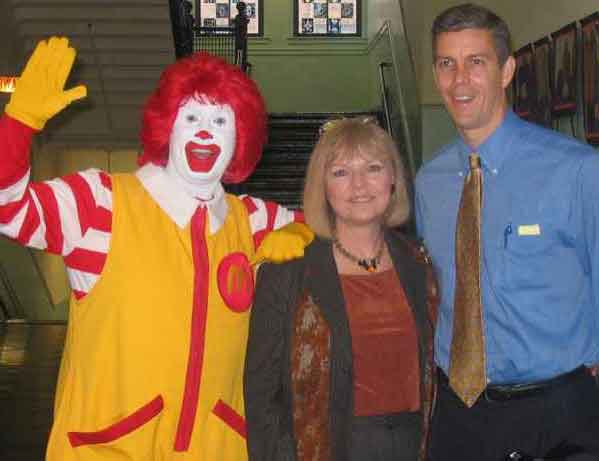
Ronald McDonald, Carol Spizzirri, Arne Duncan

 Yesterday, I posted here an open letter to US Secretary of Education Arne Duncan about a burgeoning scandal involving the Save-A-Life Foundation, its founder, Carol Spizzirri, and Chicago Public Schools under the leadership of Mr. Duncan.

Here are follow up links to a blog post the late Gerald Bracey was working on when he died in 2009, examining this same troubling situation.

First, two posts by Susan Ohanian: AN OPEN LETTER TO US SECRETARY OF EDUCATION ARNE DUNCAN.

Second, her original post of Bracey's column on Duncan and Save-A-Life:

News delayed is news denied.... The Skeleton in Arne Duncan's Closet

Ohanian's post of Bracey's column was picked up at the same time at two other sites, SUBSTANCE and SCHOOLS MATTER

Finally, here are two videos from Chicago's Channel 7 I-Team investigation of the Save-A-Life Foundation, "The Maneuver, Part I" and "The Maneuver, Part II."

Wednesday, June 1, 2011

An Open Letter To US Secretary of Education Arne Duncan


Click here for supporting documents regarding the following.


Michael Paul Goldenberg
6655 Jackson Rd Lot #136
Ann Arbor, MI 48103
(734)644-0975
mikegold@umich.edu
http://rationalmathed.blogspot.com

June 1, 2011

The Honorable Arne Duncan
US Secretary of Education
Department of Education Building
400 Maryland Ave, SW
Washington, DC 20202

Dear Mr. Duncan:

I'm a mathematics educator working in an urban public school district. On my blog, I'm reporting about the Save-A-Life Foundation (SALF), an Illinois nonprofit with which you were associated when you served as CEO of the Chicago Public Schools (CPS). I'd greatly appreciate your answers to two brief, but serious questions.

You'll recall that SALF's charter was to provide in-class first aid training to students. According to an October 11, 2009 Chicago Tribune article, SALF founder/president Carol J. Spizzirri claimed “2 million children took the classes, many of them from the Chicago Public Schools.”

According to news reports, press releases, and other records, from 2003 through late 2006 you lent your support to Spizzirri's organization in various ways, including appearing as an animated cartoon character on SALF's website.

Subsequently, a November 2006 ABC7 I-Team story reported that SALF and Spizzirri engaged in a variety of serious misrepresentations. In that broadcast, you yourself raise doubts about SALF's claims. Since then, the organization has been the subject of dozens more media exposes including an October 11, 2010 article in The Hill reporting that SALF was under investigation by the Illinois Attorney General's Charitable Trust Bureau. An investigation by the US Centers for Disease Control and Prevention also appears to be underway.

Here's why I'm writing. In response to a federal court subpoena and FOIA requests, the only records produced by CPS indicate that at best a few dozen students ever participated in SALF training classes. As result, Chicago Schools Inspector General James M. Sullivan has been asked to investigate what happened to approximately $62,000 CPS awarded to SALF, most of which was arranged by you. Records show that you contracted with Spizzirri to provide first-aid training for approximately 18,000 students from 2004-2006. You signed off on $49,000 in CPS funds and Ronald McDonald House Charities provided an additional $125,000, making a total of $174,000 paid to SALF for what appears to be a program that never happened.

Given the facts, do you think Inspector General Sullivan should proceed with an investigation? And would you co-operate with such an investigation?

Thank you for your consideration and I look forward to receiving your answers.

Sincerely,
Michael Paul Goldenberg

cc:
Justin Hamilton, Press Secretary
US Department of Education
Peter M. Heimlich, MedFraud.info

Sunday, May 22, 2011

You Say You Want A Revolution? Try Some "Inconvenient Truth" About Deformers


                                  Brian Jones and Julie Cavenaugh:
                                  Two Courageous Teachers

I had the pleasure and privilege of attending the premiere of THE INCONVENIENT TRUTH BEHIND Waiting For Superman on Thursday night and hearing the excellent panel discussion afterwards. This is a movie that, as Diane Ravitch said, needs to go viral. Go here to request a copy: http://www.waitingforsupermantruth.org/ Consider showing it wherever you can. And think about this: we're individuals, working collectively, to fight a small number of billionaires and their pawns and puppets. There are vastly more of us than there are of them. Our futures and those of our children and grandchildren are at stake. The very essence of democracy and the role of free public education therein are facing serious threats, not from foreign forces or terrorists, but from corporate interests and the super-rich. Every major US city, particularly where there are a lot of poor and minority people, faces a direct threat from privatization, but ultimately, if the deformers are allowed to win, they will spread their poison everywhere.

Consider making versions of ITBWFS that focus on your city or region. LAUSD, Chicago, Washington, DC, Baltimore, Detroit, New Orleans, Philadelphia, St. Louis, and Miami are some of the most immediate, obvious targets, but no doubt there are many others.

Diane Ravitch said on Thursday that no billionaires are coming to save us or do the hard work for us. We have to do it ourselves. And it's about time we did.