Friday, February 20, 2009

Are "Both Sides" in the Math Wars Dogmatic Absolutists?


In response to one of Wayne Bishop's usual assaults on someone who deigns to write or speak positively about progressive mathematics education, Bill Marsh wrote, in part:

Wayne follows Wu by starting with one way of doing something, then dogmatically claiming and perhaps believing that it is the only way. This happens on both sides of the math wars, usually in the weaker form of merely claiming there is only one best way.

I wrote back to Bill, a mathematician with whom I generally agree about educational issues:


I wonder what you mean when you say "This happens on both sides of the math wars." Assuming that the antecedent of "this" is "claiming and perhaps believing that it is the only way," I would suggest that I've yet to see someone on MY side of the Math Wars debates take the view that there is only one way to do or think about anything, particularly when it comes to teaching and learning mathematics.

The anti-progressive side has been pulling a cute trick for a long time by citing a couple of types of things that make it appear that those they oppose are just as outlandishly rigid as they are themselves. One sort of evidence is teachers who are not involved at all in the sorts of debates that arise here and in similar places, but rather are rank-and-file folks who have "caught the reform bug," so to speak, but haven't given it a lot of thought. They may have caught it because their district mandated a particular curriculum, or because of a conference session, or from a colleague, and suddenly they are True Believers in the worst sense. They become just as rigid and unreflective about their latest religion as they are about every previous one and as they will be about the next one. Such folks are not, on my view, progressive teachers, and their lack of reflection and insistence that they've found some new panacea (be it manipulatives, problem-solving curricula, technology, games, a particular math textbook or series, small-group work, project-based learning, or anything else) makes them simply folks who will likely jump on many more bandwagons with just as little thought and understanding. They are not really any different from unreflective teachers who glom onto Saxon Math, programmed instruction (back when that was the fad), or a host of other things that don't happen to be part of the progressive/reform menu. Approached with little or no thought or reflection, such things aren't answers either, but of course a True Believer always thinks s/he has found magic, not realizing that magic doesn't exist (at least not of that sort).

Another major sort of evidence anti-progressive ideologues have used is to find little snippets of things people associated with reform say that they can build into ultimate proof that the REAL progressive reform agenda is racist, fuzzy, watered-down, inferior, extremist, and so forth. A classic example is what was culled from a radio interview given in 1996 by the then-president of NCTM, Jack Price. Wayne and his Mathematically Correct/HOLD friends have come back to that little bit of decontextualized spoken prose as damning evidence of patronizing racist and sexist attitudes not only on the part of Jack Price, but the entirety of all progressive reformers. While this is hardly the only example of such things, it serves as the archetypical one to my mind.

A third example, somewhat similar to the second, is taking lines from articles by progressive reformers that are clearly intended to shock people out of their complacency about mathematics education and, again, use them to attack EVERY progressive reformer and progressive idea. Two cases in point are Tony Ralston's piece, "Let's Abolish Paper and Pencil Arithmetic," suggesting the seemingly radical idea in the title (his very sensible call in the same article for increased emphasis on teaching estimation skills and mental arithmetic is conveniently ignored by the critics, of course), and Steve Leinwand's 1994 piece in EDUCATION WEEK, "It's Time To Abandon Computational Algorithms." A fair reading of the article makes clear exactly what Leinwand proposes, but it's more effective rhetorically for critics to cite the eye-catching opening paragraph rather that the reasoned argument that follows, especially when in the third paragraph Leinwand makes crystal clear that he isn't calling for an end to teaching basic computation skills, but rather asking that we take a much-needed critical look at WHICH computation skills we teach and what alternatives exist for kids who don't necessarily "get it" as quickly as conventional wisdom says that they "should" (always a word that is popular with the MC/HOLD folks and others who wish to trash progressive reform notions).

While the above three sorts of maneuvers hardly exhausts the list of what anti-progressive reform attackers are very wont to do, they are the ones most immediately relevant to the question of whether Bill's comment above, if I've gotten its intent right (and it's quite possible that I haven't), applies equally well to "both" sides (of course I think there are many more than two such sides) in the Math Wars. And in my experience, it's simply not the case in any meaningful way that progressive reform theorists, advocates, and reflective practitioners are guilty of the sorts of dogmatic absolutism that so thoroughly characterizes the views of their vehement critics and opponents as seen on the websites of Mathematically Correct and NYC-HOLD.

Saturday, February 14, 2009

It's About Time: Obama On Science

Sometimes there's nothing to add other than my wish that the speaker succeed in not only being heard, but heeded, and my gratitude for having been around when an intelligent, articulate, and above-all humane person once again holds the most powerful elected position on the planet.

Wednesday, February 11, 2009

Reducing Class Size VERSUS "Best" Instructional Practices (and other rants by yours truly)


A recent commentary "It's Not All About Class Size" appeared from Ken Jensen on the discussion list of the National Council of Supervisors of Mathematics (NCSM):

I agree with the assertion that, "it is possible that smaller classes will actually widen the domestic achievement gap between the haves and have-nots." and the explanation as to why this may occur is well thought out. However, the article is void of any suggestions as to how we might increase achievement for all- both raise test scores and close the gap.

I would like to propose that a teacher with a well developed sense of best instructional practices does much more to increase achievement for all students than lowering class sizes. In fact, I would want this teacher's class to be full to the brim so that as many students can take advantage of this learning environment as possible, and I would expect this teacher to raise the achievement level of all his or her students in spite of the large size.

So much has been written about what makes for good instruction and yet it is so elusive in America's schools. Let's take the money the politicians would use to lower class sizes and instead use it for in bedded professional development. The coaching model as developed by Lucy West and Catherine Casey is making a difference in the district where I work, and I promote it everywhere the conversation comes up.


My response, which of course is to more than just what Ken wrote above:

Seems a bit puzzling as to why this is an "either/or" situation. EITHER we decrease class sizes OR we try to improve the quality of teaching? Why not both if each is important?

Effective classroom coaching is an important part of the story, no doubt. So is, I think, reduced teaching hours per day, more opportunity for collegial observation and interaction (as long as the school creates and supports actual professional development during the non-teaching hours, rather than offering more planning periods that are spent grading or talking about baseball (not that I oppose giving teachers time to grade, but not INSTEAD of meaningful collegial interaction and professional development. And much as I like baseball, I've sat as a guest in far too many math teacher lounges where that was the main subject, when bashing individual kids or certain "kinds" of kids was not, and no mathematical or pedagogical issues were ever raised at all)). So is lesson study, which incorporates features involved in coaching, planning, collegial feedback and observation, etc.).

As to the idea of cramming as many bodies as possible into the classrooms of the "good teachers." How long before they become burned out by their increased grading load? How long before you destroy the classroom culture by making the carefully-crafted dynamics impossible to rebuild or sustain? I think that's a rather questionable suggestion at best, unless of course you assume that the "magic' this teacher is doing is completely grounded in some sort of fabulous lecturing, a doubtful proposition in my experience.

And as long as I'm scatter-gunning here, I am for some reason skeptical of the phrase "best instructional practices" for a couple of reasons. First, I think teaching remains far more an art than science (not unlike pretty much everything else in the social sciences. I'm working on a blog entry about the relationship between psychoanalytic practice and jargon and educational practice and jargon. Suffice it to say that the more the jargon, the less impressed I am by the what's being spoken of, assuming I can piece out what that might be). The notion of "best" instructional practices sounds a little too smug and reminds me of how the word "authentic" gets used in the writing of some educational researchers and pundits: if what YOU are doing is "best" or "authentic," where does that leave me? I have this same reaction to the Core Knowledge Foundation gurus, who tout the solution to our educational woes as "teaching content." Obviously, since I don't subscribe to their religion, I must not be teaching content. Or at least not the "right" content.

I prefer to think about instructional practices as a palette from which we choose depending on the vicissitudes of daily teaching reality. It is not a scientific process. If it were, I could mail in my lessons (and my instruction). Yes, there are some things I choose quite consciously not to have on my particular palette. And some things I have in very small supply and use sparingly by design. Beyond that, I can't claim to know in advance what classes will be like other than in broad strokes, and the rest comprises details that emerge as part of an organic process that cannot be accurately foreseen. Stuff happens when you're dealing with human beings. And lest we forget, the main instrument we use to both teach and to assess the effectiveness of that teaching on a moment-by-moment basis as well as upon latter review is a flawed one: ourselves. That's fine, since we're all in the same boat. But I for one am tired of being asked to pretend that teachers or educational researchers, teacher educators, coaches, curriculum developers and authors, administrators, or others involved in the instruction process are objective scientists or anything of the sort.

Set rant to [OFF].

Tuesday, February 10, 2009

Core Knowledge: Who Are the Snake-Oil Salesmen?


The following was recently posted on math-teach by the always-remarkable Professor Wayne Bishop, who never saw a progressive educational idea he didn't despise:


http://www.coreknowledge.org/blog/2009/02/03/21st-century-snake-oil/


21st Century Snake Oil

Published by Robert Pondiscio on February 3, 2009 in Core Knowledge, Curriculum and Education News. Tags: 21st century skills, Alfie Kohn, content knowledge, critical thinking, Curriculum, Jay Greene, Tony Wagner.

Yesterday, Alfie Kohn; today Tony Wagner.

Jay Greene goes after the education guru on his blog and in an op-ed in the Northwest Arkansas Morning News. The Fayetteville Public School system has purchased 2,000 copies of Wagner's The Global Achievement Gap and is holding a series of public meetings, according to Greene, on how Wagner's vision for 21st century skills "might guide our schools." Be afraid, says Jay. Be very afraid.

It's hard to get people to think critically about people who push a focus on critical thinking. To be for critical thinking is like being for goodness and light. The tricky part is in how you get there. To the extent that Wagner has any concrete suggestions, he seems to be taking folks down the wrong path. He wants less emphasis on content and less testing. But he shows no evidence that higher levels of critical thinking can be found in places or at times when there was less content and less testing. In fact, the little evidence he does provide would suggest the opposite.

Joanne Jacobs weighs in as well, pointing to a Sandra Stotsky op-ed on Tony Wagner, and noting succinctly: "I don't see excess knowledge as a big problem for today's students."

Cultural Literacy Bonus: Check out the illustration atop Jay's blog post. It's Bugs Bunny dressed as a Wagnerian Valkyrie from the cartoon, What's Opera, Doc? Can you imagine a kid's cartoon using Wagner's Ring Cycle as the basis of a parody today? It's a bromide to suggest that entertainment has been dumbed-down over time, but it's hard not to notice the difference in the vocabulary of Mary Poppins, for example, or the Rex Harrison version of Doctor Doolittle compared to contemporary kids' fare. Quantifying the change in cultural references and vocabulary level in children's entertainment over the last 50 years or so would make for an interesting study, if it hasn't already been done.


Well, pardon my lack of excitement at the above from Bishop and his Core Knowledge buddies, but I felt compelled to craft a response:

Just reading the name of this blog and the first few lines had me in hysterics (the fun kind).

"The Core Knowledge Blog

Closing the Achievement Gap: Teaching Content"


Funny. And the rest of us are, of course, NOT teaching content. Sez the Hirschies.

Of course, they have a very narrow definition of what comprises "content": namely just precisely what THEY say it is, and nothing else. Beware! Fascism lurks here.

Then, the blogger quotes Jay Greene in order to attack Mr. Wagner (whose ideas are not particularly appealing to me, but clearly any enemy of my enemy deserves my consideration):

"It’s hard to get people to think critically about people who push a focus on critical thinking. To be for critical thinking is like being for goodness and light."


Yeah, and being "for content" is not a pile of equally empty baloney? Doesn't "which content" matter? Oops. See above. THEIR content, of course. Want to know which? Pay Mr. Hirsch and pals and they'll sell you all the books you don't need to find out what a narrow-minded old white guy thinks your Nth Grader "needs" to know. And just as a reminder: this is the "educational expert" whose credentials are being a literature professor at University of Virginia who suddenly decided he could make a lot more money shilling guides to K-12 educational content. And whose literary theory is that there's one right interpretation to every literary work, based on the "intention" of the author (apparently he managed to ignore the notion of the "intentional fallacy" or simply figured no one would notice that his view was outdated and for the most part irrelevant). This is the guy you want telling you what you and your kids need to know? I think you could do just as well to get advice from MEIN KAMPF, THE LITTLE RED BOOK, and THE EXECUTION ORDERS OF JOSEPH STALIN (okay, I made that last one up).

And then we have this bit of sophistry:


"Cultural Literacy Bonus: Check out the illustration atop Jay's blog post. It's Bugs Bunny dressed as a Wagnerian Valkyrie from the cartoon, What's Opera, Doc? Can you imagine a kid's cartoon using Wagner's Ring Cycle as the basis of a parody today? It's a bromide to suggest that entertainment has been dumbed-down over time, but it's hard not to notice the difference in the vocabulary of Mary Poppins, for example, or the Rex Harrison version of Doctor Doolittle compared to contemporary kids' fare. Quantifying the change in cultural references and vocabulary level in children's entertainment over the last 50 years or so would make for an interesting study, if it hasn't already been done."


I wonder if this genius actually bothers to watch today's cartoons. Of course, first he pulls a little bait and switch: cartoons and Wagner (and who does he think was supposed to 'get' that joke? Four year olds? No more than the writers of Rocky and Bullwinkle expected little kids to know that Boris Badenov was a play on Boris Gudenov. There have ALWAYS been jokes in kids' cartoon shows that are for the writers and other adults. And such things are far MORE widespread today than ever. I could cite dozens of shows and movies ostensibly pitched at kids, from SPONGEBOB SQUARE PANTS to RUGRATS to Disney's ALADDIN to BILLY AND MANDY (and on to more sophisticated fare for older kids and up, like SOUTH PARK, AQUA TEEN HUNGER FORCE, ROBOT CHICKEN, FAMILY GUY, etc.) in which the references are multi-layered, culturally sophisticated, and fraught with vocabulary and references my son constantly learned from and continues to learn from. As he gets older (nearly 14 now) he sees levels of things in these shows he missed when he was younger. No kidding: just as I am amazed at things in those old WB cartoons and CRUSADER RABBIT, BEANIE AND CECIL, etc., that went right by the much younger me at the time they first aired or I first saw them). And then suddenly we're talking about Mary Poppins and Doctor Doolittle. Nice. So then let's compare the vocabulary in those books (as well as the sophistication of ideas presented) with Harry Potter and Philip Pullman's HIS DARK MATERIALS trilogy, to be fair and accurate? Or would that ruin the sales pitch for Core Knowledge?

Let me sum up: Wayne and his Core Knowledge pals are the snake oil salesmen. Don't buy it, it's really bad for you and expensive as well

Monday, January 5, 2009

Lisa's Method: A New Arrangement For Calculating Slope

Lisa’s Method: A New Arrangement For Finding Slope


The National Council of Teachers of Mathematics continues to advocate for more student-centered mathematics teaching (NCTM, 2000). One of my dreams as a mathematics teacher and tutor is to have a student come up with an innovative approach to doing or thinking about some mathematics. And one of my nightmares is hearing of or seeing a student do something creative and be ignored or slapped down by an insensitive or ignorant instructor who fails or fears to consider that a student’s ideas about something might be of value. One of the worst aspects of “sage on the stage” mathematics teaching is its propensity for minimizing opportunities for students to do any thinking in class that strays from the teacher’s directed and generally very beaten path.

Recently, I had one of those much-desired opportunities to see a student spontaneously come up with what was, to me at least, an original approach to something that is easy for and familiar to many, but distressingly hard for a significant number of students: calculating the slope of a straight line given two points. My student, Lisa, had been working her way through a computer-based first semester geometry course and came to me unsure about how to find slope. As I anticipated, her problem centered the question of where to put the x- and y-coordinates in the slope equation. She was given the points (3, 2) and (-2, -4) with a picture of the graph, so I began by asking if she could tell from the graph whether the slope would be positive or negative. Once she was clear that the slope of a line that went up from left to right had to be positive, which was indeed the case with the line in question, I modeled for her how to draw a right triangle by extending a vertical segment down from (3,2) and a horizontal one to meet it from (-2, -4). I then asked her to find the lengths of the two legs of this triangle (5, and 6, respectively): an advantage for many students of this graphical approach is that lengths are positive regardless of the presence of negative numbers amongst the coordinates, and it is relatively easy for them to see or be convinced that adding the distances left and right or above and below the axes, respectively, as all positive numbers will get the correct lengths.

We then turned to the question of which of these numbers was the numerator of the slope. I offered the idea that slope represents a ratio of change between the vertical change of the line, positive, negative or zero, to its horizontal change from left to right, using the notation Dy/Dx, which Lisa responded to as something she knew from her physical science courses, stating, “Yes, that was how Ms. Acree [her science instructor] showed me.” I wasn’t sure, however, if Lisa saw that this was just a compact way of showing what we had looked at graphically, as well as indicating what calculations had to be done. When I asked if she knew what to do next, she said, “I’m not really certain.” I wrote Dy/Dx = (y2 - y1)/(x2 - x1) and asked her if that made sense. At that point, she said, “Oh, now I see why I keep getting the problems wrong: I’m putting the x’s on the top.”

Of course, this error is one all-too-familiar to mathematics instructors around the world. Countless students have lost untold numbers of points on exams due to this simple and understandable error. After all, x comes before y in the alphabet. And the x-coordinate precedes its partner y-coordinate in every ordered pair. Why wouldn’t it “come first” when writing the ratio for slope?

While we can all sagely agree that students “shouldn’t” make this error based on the underlying meaning of slope, as I pointed out to Lisa before going to notation, it is useless to speak about what is supposed to happen given what so often does. Much as it is important to try to get students to think clearly about the meaning of the mathematics they write and calculate with, it is difficult to ensure that this particular error, one I sometimes start to make myself if I’m not careful, does not occur.

To check her understanding, I posed a second problem to Lisa, giving her the points (3, 9) and (1, 1). She solved the problem graphically first, but was still a little unsure about doing it algebraically, so I did the usual set-up, writing m = (9 - 1)/(3 - 1) = 8/2 = 4.

Lisa looked at what I’d written down and suddenly took the paper and wrote something down, saying, “Couldn’t you do it like this?” (See Fig. 1)


Fig 1: Lisa’s Method

After looking at this for a few seconds, I thought that I understood what Lisa’s intentions were. However, I could see problems with her notation. To check, I asked what the symbols between the numbers in parentheses meant and she made clear to me that they were dashes, not subtraction signs. I asked about the slash and she said, “Oh, that means that you divide the two into the eight to get four, which would be the slope.”

This was what I thought she meant, but I asked her if it seemed possible that most people would be confused by what seemed like indicated subtractions, and if she felt that math teachers would be very distressed by the idea that what she’d written at the bottom should be read the way she intended. She said, “Oh, I see what you mean about the dashes. But I don’t see what’s wrong with the bottom part.”

I said that in fact she appeared to be claiming that two divided by eight equaled four rather than one-fourth. But I believed that I saw an easy fix to what she had done. I then wrote below her figure (see Fig. 2)
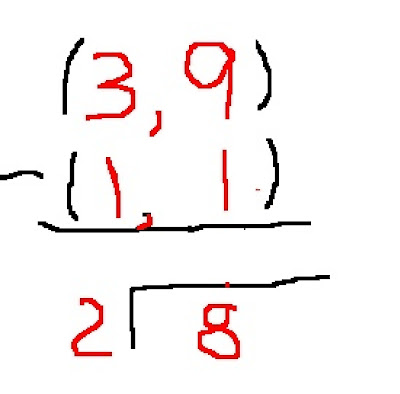
Fig 2:Teacher’s Version

This seemed more consistent with what was intended and didn’t use any non-standard or misleading notation. I asked Lisa if what I had done made clear what she wanted; she agreed that it did. The logical continuation would then be to perform the indicated division to get the slope (See Fig. 3)


Fig. 3 Teacher’s Version Completed

This correctly completed the solution for finding the slope of the line that contained the two given points.

Lisa said she agreed with the changes I’d made. At this point, I said: “I have never seen anyone find slope like this. Did another teacher show you this?” She answered, “No, but when I saw how you did it, it just seemed to me that this would work. It seemed natural to me.”

I asked her explain why this seemed like a good way to her. She said, “Well, we always did subtraction problems like that: it seems easier to me when the numbers are lined up this way.”
I told her that I thought she might have invented an original approach that made sense, and that I was going to write up what she’d done for publication so that other teachers would have a chance to share it with their students. I think she believed I was pulling her leg, and though I tried to make clear that I was serious, even when I told her again at the end of class that I was definitely impressed by her approach and was going to write it up, she appeared skeptical.

What seems useful about Lisa’s method is that it solves the typical problem of forcing students to put the y-coordinates “first,” out of alphabetical order, when they may still be struggling to simply get a handle on what slope is and how to interpret it. So many students learn (and are often taught) mathematics in a mechanical, procedural way, and in the case of calculating slope, there is something counterintuitive about how we set up the ratio, even though we would like it to make sense. Clearly, solving the problem using her approach avoids putting students in a position where many will lose points on exams and become frustrated with this vital part of dealing with linear equations and their graphs. In the long run, I would expect that when they have a firmer understanding of slopes as ratios of change and of what it is that is changing relative to what (dependent variable relative to unit change in independent variable), they will become more comfortable and effective with the traditional approach. And of course, some students will be perfectly fine with the usual way of finding slope and will likely eschew Lisa’s alternative. However, as another possible way to set up this important calculation, it seems to have promise for struggling students.

Of course, I don’t mean to suggest that her method (or any approach) is a panacea for all possible student difficulties. Naturally, students still need to know how correctly subtract signed numbers. While my work with Lisa suggested that she was comparatively clear on integer arithmetic (based on work we did previously), most of my students are typical in struggling greatly with both the procedures and concepts in this regard. That is one reason I would strongly suggest that teachers have students find slopes of lines with points in the first quadrant and/or on the axes defining that part of the Cartesian plane. Further, it seems an aid to reviewing the requisite arithmetic to then have students solve problems graphically (using right triangles as I demonstrated to Lisa) before doing the symbolic arithmetic when including points in the other three quadrants.

For Lisa, the question of finishing the problem with dividing a smaller positive integer into a larger one was unproblematic. Further experimentation with numbers of opposite signs or with two negative numbers caused her no difficulty either, and she successfully concluded in cases that resulted in both proper and improper fractions that as long as she reduced to lowest terms, no further adjustment was needed to the results she calculated with her method. However, it is not at all obvious that this would be the case for all students, so further investigation along these lines will be important.

If nothing else, what Lisa has done can be shown to students as an example of creative solutions to simple but annoying sticking places for many teachers and students. I’ve personally never been happy with the “rise over run” idea, though I offer it to students as a mnemonic, because the word “run” doesn’t communicate horizontal motion to me clearly, even though it does to some students. I also worry sometimes that it locks students into thinking of slope too literally as restricted to a graphical interpretation, rather than keeping open the idea of slope as a ratio of change between dependent and independent variables.

Lisa seems to have spontaneously created something that for me might solve a nagging pedagogical problem: how to teach students to calculate the slope of a line from two given points without having to do something that for many does not come naturally. The key here for me (and I hope for teachers reading this article) is that I was open to seeing Lisa’s ideas and that we had established the kind of relationship where she felt comfortable sharing what seemed like a spontaneous burst of creativity with me. While it is far easier to be receptive to student thinking in the one-on-one teaching I often do as a consultant, coach, guest teacher, or in full-time work as a Title I mathematics teacher, I believe it is vital that teachers in more typical group and whole-class teaching situations remain open to opportunities to explore student ideas. As the work of teachers like Ball (1993) and Lampert (1985) shows, teachers must make dozens of decisions about such moments, and it is easy to lose them under the pressure to “cover the curriculum.” But if we are serious about teaching mathematics in ways that value and promote independent student thinking and active participation in a mathematical learning community, we cannot afford to miss the unexpected. At worst, we need to note when students have provocative, promising mathematical ideas so that we can revisit them later with their authors and other students. It’s not always possible in the heat of a lesson to see whether an idea warrants taking a detour from the official planned route. Even if something needs to be put on the back burner, it is important that students know that their ideas are valued, and vital that the teacher get back to the student to discuss and explore such insights and speculations further. And of course, it is necessary that teachers have adequate mathematical knowledge to recognize the potential significance of their students’ ideas (Ball, et al, 2005). But the more teachers take their students seriously as sources of rich mathematical ideas, the more likely it is that students will engage more fully in mathematics and indeed produce surprising and fruitful ideas.

References

Ball, D. L., Hill, H.C, & Bass, H. (2005). Knowing mathematics for teaching: Who knows mathematics well enough to teach third grade, and how can we decide? American Educator.

Ball, D. L. (1993). With an eye on the mathematical horizon: Dilemmas of teaching elementary school mathematics. Elementary School Journal, 93 (4), 373-397.

Lampert, M. (1985). How do teachers manage to teach?: Perspectives on problems in practice. Harvard Educational Review , 55 (2), 178-194.

National Council of Teachers of Mathematics (NCTM). Principles and Standards for School Mathematics. Reston, VA: NCTM, 2000.

Tuesday, December 9, 2008

Pinning The Blame On The Wrong Donkeys: A Response to "The Problem With Math Education"


The latest post on the blog "The Math Mojo Chronicles" states in part:

The Problem with Math Education
Filed under: math education, public schools; Author: Brian; Posted: December 8, 2008 at 8:18 pm;

Well, of course it’s not the problem, just one of many, but here it goes…

Somehow along the way, people got the feeling that math is supposed to always be right, and that math teachers are supposed to know all the answers.

Math has gotten the reputation of being an authoritarian science. I don’t think this is the fault of mathematicians, I think it is the fault of many math educators who have tried to turn mathematics from an art and science into a “subject.”

Math education is all too often about “standards” and “curricula” that students take “tests” about that they are “graded” on.

If Archimedes was to take a high-school math test today, he would be unfamiliar with the jargon, and would find little value in the trite little multiple-choice and partial credit nonsense that passes for assessment.

On the other hand, he could run rings around the math teachers with his knowledge of actual mathematics, and could twist their pedagogical dogma into moebius bands.

Trying to shove math into the education industry’s rubric is one of the worst educational crimes I can think of. School math seldom has anything to do with actual math, except for the very rare cases where an inspired person is doing the teaching. And when that happens, that person is invariably in trouble with the administration....


Click here to read the entire blog post.

A Mathematics Educator's Reply

I posted the following response to Brian's blog entry this morning:

As usual, I find your use of language problematic in a variety of ways. First, let’s take:

“Math has gotten the reputation of being an authoritarian science. I don’t think this is the fault of mathematicians, I think it is the fault of many math educators who have tried to turn mathematics from an art and science into a ’subject.’”

My gripes here are first as an ex-English teacher: do you mean “authoritarian” or, more likely, “authoritative”? The latter makes more sense in the context you’re speaking about, but the former is possible if you mean to imply that mathematics is somehow about bossing people around. Of course, mathematics can do no such thing, though mathematicians and those who use mathematics certainly try to do that a great deal of the time.

Second, I would be awfully careful about how you use the term “math educators” these days. In the “Math Wars” era, that’s come to mean almost exclusively people with advanced degrees, generally doctorates, in mathematics education, an academic field focused on research on math teaching and learning, as well as upon teacher education. And I seriously doubt that it’s those folks who are centrally responsible for the problem you mention.

You need to look at who tends to hold major sway these days (since the late 1990s) in many states and on a national basis regarding state curriculum standards. It isn’t for the most part mathematics educators, though occasionally they get to have some say. Look, for example, at the Presidential National Math Panel. Exactly how many “mathematics educators” were on it? I count three. Liping Ma, Deborah Ball, and Skip Fennell. The rest were mathematicians, cognitive psychologists, one middle school math teacher with a long track record of hostility to what we can loosely call “reform mathematics education,” and a bunch of other folks whose presence on such a panel would be puzzling were it not one called under the watch of George W. Bush, not exactly known for giving much of a damn about actual educational or scientific expertise (see THE REPUBLICAN WAR ON SCIENCE for starters). The folks who undid two decades of reform work in California were, to a man (and I use that word advisedly) mathematicians who got in through a political back door to substitute their own state standards for the ones the legitimately appointed panel had submitted (see The Politics of California School Mathematics: The Anti-Reform of 1997-99 by Jerry P. Becker and Bill Jacob).

You then go on to talk about tests as if the folks promoting them are, once again, math educators rather than a narrow band of anti-reformers who are virtually never math ed researchers or teacher educators, but rather politically-motivated activists, some with little or no established knowledge of mathematics or its applications (but VERY loud voices), some mathematicians with a conservative educational viewpoint, and all of them openly dismissive of “mathematics education” and “mathematics educators.”

You really seem in this entry to be terribly confused about whom is to blame for the reduction mathematics teaching and learning to many things that have very little to do with what mathematics as a living field, as an activity, as a “doing” are about. It’s not mathematics educators.

Of course, many of the points you make about curriculum, assessment, etc., are a function of a system that is not really very much in the control of the folks you are inadvertently or purposely attacking here. The education “industry” is another loaded term that seems to get used to mean different things to different folks. There are of course people in education because it’s a job, a way to make a living (however limited) with what they may find minimal risk or effort. There are increasingly people in it as an explicit business (see, for example, major publishers, obviously, but less obviously perhaps those companies run by folks with no interest or training in education who are coming in through the charter and voucher routes to grab up as many education dollars as they can, often without even a passing glance at kids as any more than the income they represent. I speak from bitter personal experience in this regard, having worked for and with enough of these companies at the bottom rung (know vaguely as “teacher”), but with eyes open to the corporate memos that speak of the “business we’re in,” focusing upon enrollments and count days, but with never a mention of curriculum or, heaven forfend, learning or what students are actually getting from being at their schools. It’s uglier than you can imagine unless you’ve looked at such management companies with real scrutiny, and from the outside it’s damned hard to get access to what they’re up to. (Of course, I can provide quotations from REAL corporate memos to back my assertions).

Many on-the-job math teachers and mathematics researchers and teacher educators are not of this ilk. They’re hard-working people with a passion for mathematics and for kids. They actually interested in seeing kids become effective with and excited about math and its applications, beauty, and power. And they are trying to find math curricula (read “books, lessons, materials, tools”) that are effective in engaging and educating kids. They’re also interested in teaching: how to better get key aspects, concepts, techniques, procedures, applications, implications, and pleasures of mathematics across to kids.

Your penultimate paragraph talks about questions. And of course that’s a huge part of what math and education are about. But questions in math and in math class are pedagogical issues, not purely mathematical ones. They’re the stuff many math educators but too few mathematicians and virtually no business people or politicians are concerned with in this thing we’re all fighting about. You have identified some of the problems, but your loose language and lack of focus once again appears to be pinning blame on the wrong donkeys more often than not.

Tuesday, November 25, 2008

What Can Division Tell Us About Multiplication? (Part 2)

Preface

This post has been sitting in the hopper since the beginning of November. Due to a number of conflicting writing projects and a major presentation I've been preparing to give on Dec. 1., I'm at a point where I need to either fish or cut bait with this now, pending a lot of reading that I don't have time to do immediately. My decision today is to post this "as is," with the major investigation of existing research left hanging fire until I have time to do it real justice. So for some readers, this second post may disappoint, not getting to what I personally think is the nitty-gritty that must be explored to determine whether Keith Devlin's heuristic columns on multiplication and repeated addition are simply provocative pieces that fail to lead to urgent rethinking of how we present multiplication to students in K-12, or if in fact he has put his finger on something mathematics teacher-educators and elementary and middle school teachers need to take very seriously indeed. I continue to try to occupy a semi-moderate middle ground, not happy with some of the inflammatory language that has been used by various participants in the debate (including Devlin himself, of course, though I believe he did so with the intention of stirring up things; regardless of intention, he clearly succeeded in provoking a lot of discussion, some of it actually quite productive), but unwilling to buy the simplistic viewpoint that there's nothing underpinning Devlin's ideas that need to be looked at carefully from the perspective of what we teach kids and how regarding multiplication.

Part 2

Previously, I explored two major interpretations of whole number division, the partitive (sharing) and quotative (measurement) "models." My purpose was to see how well these interpretations work for whole numbers (though they do not exhaust possible interpretations), and also how these interpretations are almost, but not quite adequate for integers. The problem comes when one tries to interpret dividing a positive integer by a negative integer using either of these ideas: there's simply no way to make sense of them. Of course, looking at division as the inverse of multiplication solves that problem readily. And there are other interpretations of multiplication and division that might do equally well.

But my initial purpose for looking at division and interpretations of it was to see what light, if any, it could shed on meanings for multiplication. In particular, my concern was to see whether "repeated addition" sufficed as a definition for multiplication, given Keith Devlin (and other's) insistence to the contrary. Minimally, he asserted in his most recent column on this continuing controversy that teachers should not leave students with the impression that multiplication is "nothing more than repeated addition."

One hint that multiplication can't simply be repeated addition comes from the above-mentioned breakdown of the two interpretations of division of whole numbers when applied to integers, particularly the failure of the measurement model, which can also be viewed as "repeated subtraction." Though I'm very fond of using that viewpoint to help convince people that division by zero cannot result in a real number, it's clear that repeated subtraction will not result in any meaningful interpretation for 6 / (-2) = -3. There are no -2's to subtract from 6. The colored chip model, which works so well for the same examples that partitive and quotative interpretations work for with integer or whole number division, will not make any sense for this problem. Adding zero pairs and then subtracting (removing) pairs of negative (red) chips gives the wrong result. It seems that division "ain't no repeated subtraction" after all, or it least it isn't JUST repeated subtraction.

I'm not sure that I mind all that much that the repeated addition and repeated subtraction ideas don't work all the time; ditto for the chip model and the partitive/quotative interpretations. After all, these aren't definitions so much as they are interpretations or physical models: the map is not the territory. And it's pretty clear that while it's possible to stretch the repeated addition/subtraction ideas to positive rational numbers, the same difficulties will arise for signed rationals, and the entire thing will collapse when one looks at irrational numbers. I won't try to address complex numbers here, as they are well beyond the scope of K-5/6 arithmetic.

By saying that I don't mind, what I mean is not that I would abandon these notions or not use them in elementary mathematics teaching, but rather that I would insist that kids need to see OTHER ideas about multiplication and division, other sorts of models, with every reasonable effort made to ensure that: A) elementary teachers understand that "repeated addition/ subtraction" does NOT suffice for discussing multiplication/division with students; and B) that students will NOT be left with the mistaken belief that these operations are nothing more than repetitions of addition and subtraction.

So What The Heck IS Multiplication?

Don't continue if you're expecting a definitive or single answer to the above question. For one thing, I'm not a mathematician, professional or otherwise, and I would never claim to have a sufficiently deep background in mathematics to offer 'the' answer. For another, a major part of my point of view is that there are rarely, if ever, single definitions of that type, even in mathematics. Perhaps Keith Devlin is right in that regard to ask:


Why not say that there are (at least) two basic things you can do to numbers: you can add them and you can multiply them. (I am discounting subtraction and division here, since they are simply the inverses to addition and multiplication, and thus not "basic" operations. This does not mean that teaching them is not difficult; it is.) Adding and multiplying are just things you do to numbers - they come with the package. We include them because there are lots of useful things we can do when we can add and multiply numbers. For example, adding numbers tells you how many things (or parts of things) you have when you combine collections. Multiplication is useful if you want to know the result of scaling some quantity.

But then again, this quotation might just be Professor Devlin's cry in the wilderness, or perhaps it's an example of much ado about nothing. Is there really such a difference between multiplication and repeated addition?

Consider the following, offered at "TheMathPage.com," a page maintained by a former colleague of mine at Borough of Manhattan Community College, Lawrence Spector:


Here is the most general definition of multiplication:

Whatever ratio the multiplier has to 1
the product shall have to the multiplicand.
Consider this multiplication of whole numbers:

3 × 8 = 24

The multiplier 3 is three times 1; therefore the product will be three times the multiplicand; it will be three times 8.

Similarly, to make sense out of

½ × 8,

the multiplier ½ is half of 1. therefore the product will be half of 8.

Proportionally,

As the Multiplier is to 1, so the Product is
to the Multiplicand.

Or inversely,

As 1 is to the Multiplier, so the Multiplicand is
to the Product.

The Product, then, is the fourth proportional to 1, the Multiplier, and the Multiplicand.
To be perfectly fair, Spector's earlier discussion of multiplication (of whole numbers) is grounded in precisely the "multiplication is repeated addition" interpretation that Devlin decries. But in his "most general definition," he clearly sees multiplication as deeply related to proportional reasoning, not repeated addition. And this is exactly what Devlin and others see as a serious matter for concern and inquiry.

Given the critical importance of proportional reasoning in the US middle school math curriculum (or so the NCTM Standards and many mathematics educators and state curriculum frameworks suggest), and given that there is disturbing evidence that American students as a group do less and less well in mathematics as they get older, it's important to consider their performance on proportional reasoning in particular. Here, I'm not just talking about by comparison with students in other countries, since there are reasons to question whether such comparisons are accurately comparing similar groups; some critics of TIMSS results have claimed that some of the higher-scoring countries are testing a narrower band of students than does the United States. I'm talking about the general sense that the percentage of mathematically proficient students declines in America as students continue through middle and high school and into post-secondary education.

It seems reasonable to suppose that if such a decline is real, that one reason that middle school students underperform compared with elementary students is that they are not well-positioned to tackle the central curriculum focus for their grade band: proportional reasoning. (I would suggest that a continuing weakness in integer arithmetic goes along with and exacerbates this shortcoming). And I suspect that part of that weakness in handling proportional reasoning can be found in how multiplication is taught and (mis)understood.

What remains to be done, then, is to look carefully at the research that is already out there on children's mathematical thinking, as well as that of older students (middle school, high school, and college students in, say, freshman calculus) and see if and how their thinking about multiplicative situations, proportional reasoning, etc., is impacted, for good or ill, by their introduction to whole number multiplication. Is there in fact evidence that some/many/all students who are introduced to multiplication as repeated addition and left continuing to think of it solely or primarily as repeated addition are hamstrung when it comes to doing and/or understanding multiplication as they move to other kinds of numbers?

And, in due time, I hope to explore some of that research here. More to come. Perhaps much more.